John Jay Quotes
A treaty is only another name for a bargain: and that it would be impossible to find a nation who would make any bargain with us, which would be binding on them absolutely, but on us only so long as and so far as we may think proper to be bound by it ... treaties are made not by one of the contracting parties but by both, and consequently that as the consent of both was essential to their formation at first, so must it ever afterwards be to alter or cancel them.
John Jay, 1745-1829, President of the Continental Congress, Governor of New York (Federalist), U. S. Foreign Secretary, First Chief Justice of the U. S. Supreme Court, The Federalist No. 64, March 5, 1788
Sourced by: Eigen's Political and Historical Quotations


See {585493},65902, and {585496}, for more quotations on this.

The minister had refused to be pressured by the George W. Bush Administration to sign an agreement with the US agreeing never to turn over an American or a foreign national working for America to the International Criminal Court (ICC). Even if a Peruvian or other non-American were working for an American Agency as an informant, agent, or other role, the country could not respect the treaty obligations that they had already made with regard to the ICC. Peru was “punished” losing $4 million aid. Nations were so “punished” while the State Department was spending huge sums to remedy negative opinion that so many nations had developed for the US during the George W. Bush administration. See {585493},65901 & {585496}, for more quotations on this. The US did not join the ICC Treaty as in some countries political considerations and different ethical values have labeled some American legitimate behavior as criminal and have attempted to hold individuals responsible for carrying out lawful orders. So many foreigners could understand the United States not wanting to deny Americans and others in the United States the protection of the United States Constitution, there was ire at the US pressuring others to boycott the ICC and break their existing treaties.

Bolton had an idealistic view of the sanctity of treaties. For a more sophisticated “realpolitic” view, see {138034} .


The senator proposed this variation to the ancient Roman maxim in connection with the transfer of Lithuania from Nazi Germany to Stalinist Russia.

Lodge was particularly concerned that under the proposed treaty the United States would be obligated to support the League of Nations military efforts regardless of American public opinion or Congressional action.

The Constitution was not drafted until 1787 and was ratified later. In the interim the young United States functioned under the Articles of Confederation, in a sense, our first Constitution. This clause established that the Federal Government should have the exclusive power and authority to conduct foreign affairs.


Indian treaties had legal problems from the beginning of the nation. An agreement had been made at Fort Harmar with 6 Indian nations. One man signed for the United States and several of the sachems, for the Indians. President Washington reported this to the Senate and there was much confusion as to how to proceed. Typically, agents for nations negotiated a treaty but it would not be binding until each ratified it. To the Indians this was not a familiar practice. In this case, the treaty was approved for ratification by the Senate, but what kind of ratification was to be required of the Indians? The Iroquois Indian tribes had formal, methods of reaching consensus, but other nations did not. Whites sometimes reneged on later treaties on the grounds that they were not ratified by the Indian nations. In others, the Indians themselves made the same claim and challenged the right of the Indian treaty signers to speak for the tribe or nation. The problem has never been resolved.

Laws that do not work can be repealed by Congress with the President’s signature. However, if there is an international treaty, the United States may NOT change the laws to fix something that does not work. At best, the administration can try to re-negotiate the treaty, but has no power to assure the change unless, it withdraws from the treaty. However, most treaties are very complex and involve many elements and there is no way to withdraw from a single aspect of a treaty, even if it is a bad aspect.


Some people believe that the United States pressured Pakistan to enable America to support the Mujahideen in their effort to fight the Russian occupation of Afghanistan. Actually the President (and virtual dictator) of Pakistan wanted aid from America and was offering bases. America did not want bases but did want a platform for arming and training the Mujahideen, Pakistan allowed us to use Pakistan as a platform. We increased our foreign aid to Pakistan by 500 percent. There was no arm twisting.

Individual countries are bound only by the treaties and compacts that they have signed and ratified. So very often someone will allege that a country has violated international law, but that nation may not have signed the Treaty or Compact that binds them, so thy may not be in violation at all whereas some other country in similar circumstances would be. Also, many countries (including the United States) sign treaties but take exception to some of the provisions. Then there are not bound by that provision. This is what makes International Law so complicated and difficult to understand.

Turkey, in a disastrous foreign policy decision unilaterally withdrew from a major treaty and joined Germany in WWI in exchange for German support of Turkey’s treaty withdrawal. It led to the dissolution of the Ottoman Turkish Empire when Germany was defeated in WWI. Historically, it shows how easy it is for a nation to abrogate a treaty which illustrates how ephemeral treaties actually are. See De Gaulle’s wonderful quotation on this point—{138034}.
England in this quotation claims the right to interfere in the internal affairs of another nation if there is mismanagement or crises AND her national interests are affected.

This was part of the negotiation of a peace treaty with the Barbary States. The Barbary Pirates had an incredible extortion racket going in the Mediterranean. If nations would pay them an annual sum each year, they would not attack and seize merchant ships of that country and sell the ships and goods while holding the sailors for ransom. Military action on land and sea by American marines and naval ships had caused much damage and intimidated the Barbary States somewhat. See {640870}

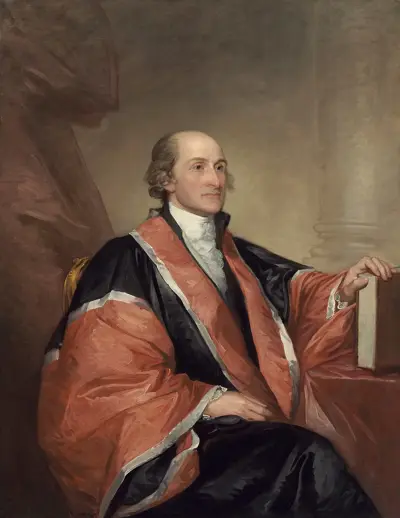
John Jay was an American statesman, patriot, diplomat, Founding Father, abolitionist, negotiator, and signatory of the Treaty of Paris of 1783. He served as the second Governor of New York and the first Chief Justice of the United States (1789–1795). He directed U.S. foreign policy for much of the 1780s and was an important leader of the Federalist Party after the ratification of the United States Constitution in 1788.
