Henry L. Stimson Quotes
A land route to Alaska is imperative for the national defense.
At the time, there was no way of reaching Alaska from the other mainland United States except by air or sea. Alaska was thought to be very vulnerable to Japanese invasion. The Alaskan Canada Highway (ALCAN) would result.
Henry L. Stimson, 1867-1950, U. S. Secretary of State (Republican), U. S. Secretary of War, Governor General, Philippine Islands, Statement, 1942
Sourced by: Eigen's Political and Historical Quotations


At that time there were extensive meetings and discussions for the creation of what was to be the United Nations. The negative view of the United Nations or other international security organization is now and always has been held by a vocal minority in the United States.


No male candidate had before or since been asked such a question.


One difficulty of diplomacy with many Islamic leaders is that the culture produces very aggressive rhetoric and very aggressive actions like Islamic terrorism. This quotation is often cited to demonstrate that it is the Iranians that had decided that America is it’s enemy; that America is to be humbled; and that their weapons development are targeted at America. This along with the most frequent Iranian slogan, “Death to America,” for many argues for preemptive military action or maintenance of a high state of readiness. Given statements like this from the leading soldier of the theocracy, there is little doubt that Iranian nuclear weapons would be a great danger to America. Therefore when Iran complains that America did not object to the fact that other nations have the nuclear bomb, they do not take their own rhetoric into account. No other nation with possible nuclear capability has made America its major military adversity and claims as an objective to humble the United States.

This was the address where FDR used the “arsenal of democracy” phrase which became so famous. A similar phrase was used in May by Robert E. Sherwood--{624748}. Then Jean Monnet began to use the exact phrase in Mid 1940--{624746}. He almost certainly had read Sherwood’s earlier, similar phrase. However so had Presidential Aid Harry Hopkins who thought that it would be a good phrase for President Roosevelt to use to “brand” the activity of the United States. So diplomatically, Monnet was asked not to use the phrase any more, and he acceded to the request. At the end of the year, FDR gave his address with this quotation.

Later, he felt that the offense had become almost invincible. See {626741}. Tesla was one of the great American immigrant scientists. He found in America the kind of intellectual and operational freedom that did not exist in the rigid, monarch-controlled, Austro-Hungarian Empire. He developed patents and techniques that formed the technological bases of radio, telephone long distance, TV, cell phones, Wi Fi, just to name a few. Most important he was Thomas Edison’s great nemesis. Edison invented DC electric generators that could power factories or entire streets in a neighborhood. Tesler invented and developed AC electrical technology which could power entire cities and he could move electricity over long distances which Edison could not. Tesler was one of the first scientists to conceive of and try to implement “Big Science” where there were huge capital investments to develop machines and systems to do what had never been done before—philosophically like the CERN Hadron Collider. Tesler even convinced a large corporation to finance the construction of a massive building and tower so he could experiment with the wireless transmission of electricity. However, as the industrial democracies have learned, Big Science can only be funded by governments and it often takes sever working in consort to afford the huge investment that is required. In Tesler’s era, the federal and state governments did not fund scientific research so his work was not only technically ahead of his time but also conceptually. He anticipated most of the problems and need for a national power grid that was challenging America even at the beginning of the 21st century.

Conant, a great scientist in his own right, had the confidence of the political, academic, and industrial establishment and was appointed to the Committee that was to set policy for the Manhattan Project representing President Roosevelt. Germany had been the world leader in Physics before the war. American leaders and scientists were certain that we were in a scientific race with the Germans. Even after Germany had been defeated, President Truman was told that we had beaten the Germans in the race for the bomb. Actually, although almost no one in the US government realized it then, the Germans had NO PROGRAM of nuclear weapons development at all. Hitler did not trust the Theoretical Physics and Theory of Relativity because Einstein and other Jewish scientists had been instrumental in its development. He derogatorily referred to it as “Jewish Science”. Germany bet its scientific efforts on the V2 Rockets and the Jet Airplane, both of which they were successful with but too late to have any material effect on the war. Ironically, even after most of the great German physicists were run out of Germany, there were still two of the greatest who may well have been capable of nuclear weapons development. But neither Werner Heisenberg or Otto Hahn were inclined to engage in that kind of research, and neither of them were even asked whether or not they thought it was possible. The anti-Semitic Nazis just assumed that it could not be. Truman and his associates did not find out for another year or more that there was no race. There was one OSS spy, Moe Berg, who had actually talked to Heisenberg in the midst of the war, and concluded that he not only was not working on an atomic bomb, but was not up on the latest pre-war critical research needed to develop a bomb. Hahn knew and had created the first chain reaction for which he later won the Nobel prize but he was a chemist and didn’t really understand the Physics and mathematics involved in making a weapon and was a confirmed pacifist. Ironically, his colleague, Lise Meitner who had done the physics and mathematics on that experiment was Jewish and had to flee Germany. In Denmark she gave the results to Niels Bohr, who shared them with Leo Slizard and Einstein when Bohr came to the United State and that initiated the famous letter that was sent to FDR which triggered the Manhattan Project. The German first nuclear reaction was used by the Americans because the politicians listened to the scientists, while in Germany, the politicians gave no credence to their scientists and their experiments in nuclear fission.
While the President had total faith in American scientists, at the time the state of American physics was not world class in several key areas. Oppenheimer, was for example, the ONLY senior American theoretical physicist at the outbreak of the war, and he had been trained in Germany. What the President did not quite realize was how many of the key scientific positions on the Manhattan Project were foreign refugees who had fled the Nazis in Europe. Many American scientists and engineers did not want to go to Los Alamos where they could not leave for the duration of the war, had to give up their own personal research, and whose relatives who did not accompany them would never know where they were or what they were doing. But there were enough great American scientists who Oppenheimer recruited that combined with the Europeans formed the greatest and most effective concentration of scientific manpower working in history.

The United States should be One major problem at the time was that the Soviet Union was supporting and instigating revolutions in many parts of the world. When most nations of the UN wanted to provide peace keeping troops to quell the conflict, the Russians would veto and block the effort, Vandenberg wanted the UN to change the rules regarding the veto. The original right of veto for the major nations was originally included at the insistence of the United States and many Americans did not want to give it up or have any exceptions lest there be more. The Russians at that time also did not want to give up any of their veto powers. Another method that Vandenberg wanted to solve the Russian peacekeeping blockage problem was for America to engage in more collective security pacts so that action could be taken without UN Security Council unanimity by going around the UN.


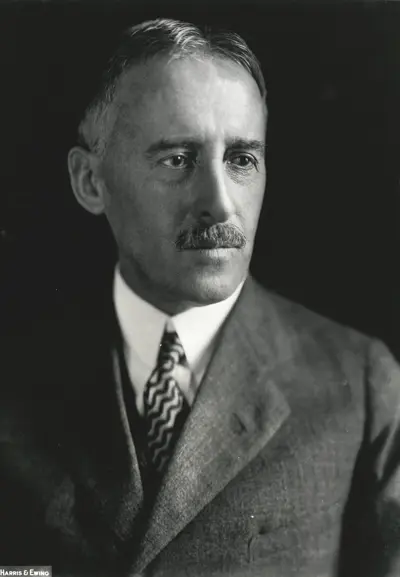
Henry Lewis Stimson was an American statesman, lawyer, and Republican Party politician. Over his long career, he emerged as a leading figure in U.S. foreign policy by serving in both Republican and Democratic administrations. He served as Secretary of War (1911–1913) under President William Howard Taft, Secretary of State (1929–1933) under President Herbert Hoover, and Secretary of War (1940–1945) under Presidents Franklin D. Roosevelt and Harry S. Truman.
