Thomas Paine Quotes
A government on the principles on which constitutional governments arising out of society are established, cannot have the right of altering itself. If it had, it would be arbitrary. It might make itself what it pleased; and wherever such a right is set up, it shows there is no constitution.
Paine, Thomas. Rights of Man. J.S. Jordan, 1791, p. 48.


Essentially, Scalia held that it was the job of the legislature to correct evils of society that he felt were not specifically mentioned in the Constitution. Other justices have argued that if the things are so evil and serious that they deny an individual the rights that were mentioned in the Constitutional, then they might be unconstitutional.

Dodd observed that FDR expanded the power of the Presidency to deal with the emergency of the Great Depression, and like most Americans hoped that these measures would succeed. The Supreme Court limited some of the power expansion to the Executive Branch, but was the start of the huge Presidential power expansion that would continue through the Cold War and the War on Terror by Presidents of both parties.


In a 1949 dissenting opinion in Terminiello v. Chicago Jackson claimed the majority view would “convert the Bill of Rights into a suicide pact.”


Character Franklin invented early in his career

The FBI had obtained a court order requiring apple to write software that could hack into a person's iPhone. Apple, with most other hi-tech companies in support, filed a motion with the court opposing the order. The FBI shortly thereafter withdrew its request for the order saying that they had found other solutions, when they had originally told the court that there were no other solutions.


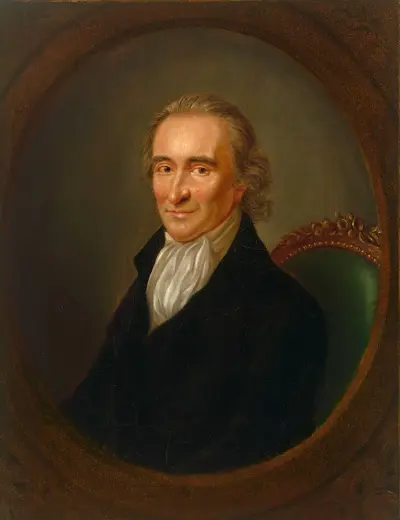
Thomas Paine was an English-born American political activist, philosopher, political theorist, and revolutionary. He authored Common Sense (1776) and The American Crisis (1776–1783), the two most influential pamphlets at the start of the American Revolution, and helped inspire the patriots in 1776 to declare independence from Great Britain. His ideas reflected Enlightenment-era ideals of transnational human rights. Historian Saul K. Padover described him as "a corsetmaker by trade, a journalist by profession, and a propagandist by inclination".
