Fisher Ames Quotes
A democracy is a volcano which conceals the fiery materials of its own destruction. These will produce an eruption and carry desolation in their way.
Ames, Fisher. "Speech in the Massachusetts Ratifying Convention." The Debates in the Several State Conventions on the Adoption of the Federal Constitution, edited by Jonathan Elliot, vol. 2, Printed by and for the Editor, 1836, p. 11.


1st Earl Lloyd-George of Dwyfor. England had occupied Iraq, expecting to be welcomed by the natives, but like the George W. Bush ill-fated invasion almost a century afterward calls for withdrawal were met by the same rationale for maintaining the occupation. The English policy makers like the Bush administration were expecting a more welcoming reaction. See {585250}.


This illustrated the problem with Nazi Germany where Hitler was elected by the people. In a Constitutional democracy such as the United States, when an elected President attempts to cut away constitutionally insured freedoms, there is public opinion, the press, a Congress and a Supreme Court to check him as occurred in the George W. Bush Administration over wiretapping, torture, and handing of war captives. These were checked, but they were minor and trivial compared to Nazi Germany’s abuse of freedom. In Germany, Hitler weakened or destroyed all those who might check his power and therein lies the essential difference. The despot must eliminate or weaken the checks on him. In the American democracy, the Congress finally checked John Adams’ Alien & Sedition Act as did public opinion by turning him out of office after one term. But in each case, in democracy or dictatorship, the same argument is often made if the elected leader impinges on some freedoms: it is legitimate because he represents the will of the people. Spencer and many others have always disagreed.

This quotation is historically important because Davis clearly states the reason for the rebellion of the South. The anti-slave states were growing at a greater rate than the slave states and despite the greater voting power that a southerner had (a result of the 3/5 count of slaves for census purposes, and the Senate), the handwriting was on the wall and the majority of the United States was against the vicious institution of slavery and would make it unprofitable, impossible and/or illegal in the coming years. Southern slavery advocates saw this as a “tyranny of the majority” and therefore took up arms. In the early 20th century, apologists for the Southern rebellion tried to promote the idea that there were reasons other than slavery, but this quotation and the resolutions of the states who withdrew from the Union make it clear that the right to maintain slavery was the only significant issue. In that sense it was a States’ Rights issue, but the South was opposed to States’ Rights when it came to States refusing to return fugitive slaves when Federal Law required such under the Dred Scott Supreme Court Decision.


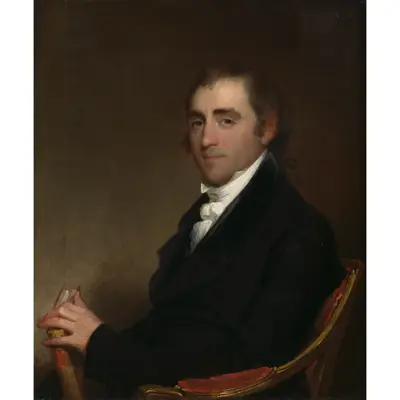
Fisher Ames was a Representative in the United States Congress from the 1st Congressional District of Massachusetts. He was an important leader of the Federalist Party in the House, and was noted for his oratorical skill.
