Thomas Hobbes Quotes
A covenant not to defend myself from force by force is always void. For ... no man can transfer or lay down his Right to save himself. For the right men have by Nature to protect themselves, when none else can protect them, can by no Covenant be relinquished. ... [The right] to defend ourselves [is the] summe of the Right of Nature.
Hobbes, Thomas. Leviathan. Andrew Crooke, 1651, p. 68.


He was threatening to shoot another Texas State Legislator, Ramon Romero, with whom he had been brawling on the floor of the Texas House of Represenatives. Rinaldi had claimed that all the Hispanics who were protesting the bill he was supporting were Illegals and called ICE. Romero objected to the Racial Profiling and generalization of many Hispanic Citizens whose ancestors were Texas Citizens when Texas became a Republic.


This is a very important quotation in that there are some who believed—then and now—narrowly that self defense is limited to responding to only physical attacks on the United States per se. Kellogg made it clear that it includes attacks on the United States and any of its possessions. Most important it allows response to any “danger” to the United States. By this definition, for example, if Saddam had been developing weapons of mass destruction in the Iraq war, the pre-emptive attack would have been self-defense. Since the claim of weapons development was bogus, it was not self defense. The key variable a reasonable danger. Nations determine that by what others do and say. In 2011, if Iran were developing nuclear weapons the U. S. could attack as an act of self defense because the Iranian highest level officials have called for “death to the United States”. When they just had the intention to harm us, there was no danger. But when they add the means to harm us to the intention, that is a danger. Likewise other nations may act in self defense if a potential enemy threatens to endanger them and has the means to carry out the threats or desires.


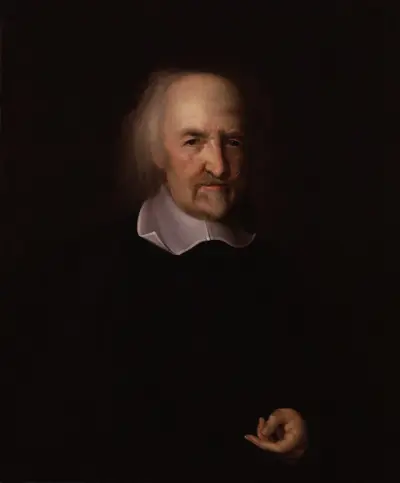
Thomas Hobbes was an English philosopher, considered to be one of the founders of modern political philosophy. Hobbes is best known for his 1651 book Leviathan, in which he expounds an influential formulation of social contract theory. In addition to political philosophy, Hobbes contributed to a diverse array of other fields, including history, jurisprudence, geometry, the physics of gases, theology, and ethics, as well as philosophy in general.
