George Tenet Quotes
… a slam dunk case
The President started the Iraq War claiming this intelligence was the main reason. Tenet has maintained however that the “slam dunk” expression was intended to convey that his assessment was that this reason for the start of a war would certainly be accepted by the American public, not that the evidence was very certain.
George Tenet, Director, Central Intelligence Agency, Description of the case that Iraq had developed weapons of mass destruction, Briefing of the President George W. Bush, December 12, 2002
Sourced by: Eigen's Political and Historical Quotations

It is noteworthy that a U. S. President had such a harsh evaluation of our major intelligence agency. Even more important in this case is that this President justified his 2003 decision to invade Iraq and start the war on the intelligence he claimed was provided to him by the CIA that Iraq had weapons of mass destruction. This quotation and the President’s view was not public at the time. I all fairness to the CIA staff, many of them had provided a number of caveats and warnings about the unreliability of the information. However, the CIA Director, George Tenant, advised Bush in a way that the caveats were sublimated. See {633093} for more detail.

In principle few disagree. However, in practice the norm of American polity is that the civilian leaders must consult the military and or intelligence leaders and take their advice seriously. If they President and his civilian leadership to not take the advice, they pay a heavy political price as there is a sometimes contradictory norm that says that you must allow the military experts to run the battles. In the given case, the Iraq War, the President and Vice President made the decision to invade Iraq. However, if we believe them literally, they were heavily influenced by the intelligence agencies who assured them that Iraq had a nuclear weapon about to be completed. It was a “slam dunk” in the words of the CIA director— {633093}. JFK as a young president did not feel that he could override the CIA and DOD people who had assured him that the Bay of Pigs lading would trigger a massive uprising in Cuba. He was misled but had to take the responsibility for the fiasco where not a single person in Cuba rebelled. The President can and should override the best military advice when it is wrong, but how does he know? If he does, he always pays a short term price—even if he is right, for that is not clear for some time. Politics in a democracy is not easy in a democracy.

Kay was chasing around Iraq trying to find the weapons that the George W. Bush administration had said definitely existed. Based on the weapons existence, the United States went to War in Iraq. No weapons were ever found.
He was the leader of the team that followed to invading troops into Iraq to find the nuclear and other WMDs that the CIA had said were deployed and ready to be used. They found none. Worse for the CIA, there were not even any development programs ongoing. The CIA Director was furious with Kay for admitting the CIA gross error. Kay was given minor assignments thereafter even though he was the best WMD analyst we had.


about Iraq possessing weapons or mass destruction This is the one of the kind of statements which many felt were prevarications to justify the President’s desire to invade Iraq. See {618461} for an example of the reaction that was generated.

The reference was to Iraq president Sadaam Hussein. The CIA had determined his location and to implement the George W. Bush administration’s policy of regime change, the Air Force had been ordered to send two Stealth Bombers with “bunker buster” bombs to assassinate Sadaam. The mission was completed flawlessly and both planes hit the target destroying it completely. However, it turned out that the CIA intelligence was inaccurate, and Sadaam was not at the location. This quotation is often used to illustrate the problem of believing early action reports and the fallibility of CIA intelligence at the time.

The CIA intelligence had been shared with key world leaders to gain support for the George W, Bush administration invasion of Iraq. Blix was bothered by the fact that although the intelligence was so certain why were not any of the locations known. The answer, of course, was that there was no such development and the intelligence was faulty, but at the time, only he seemed to be bothered by this point. See also {588115}.
He was one of the few people with knowledge about Iraq and their so called WMD program who casted doubt on the CIA and George W. Bush’s “intelligence” that Iraq was about to deploy a nuclear weapon. They anonymously tried to discredit Blix. It was Blix however who turned out to be rights.

As a member of NATO, the Prime Minister was given the same faulty intelligence that the Bush Administration gave to Congress, our allies and gave to Colin Powell to brief the United Nations. All were similarly misled. There were no WMDs in Iraq and Iraq did not even have an active program to develop them.
His catastrophic failure however was when he supported the Neocon ideology that Iraq had a nuclear bomb about to be deployed and urged a preventative war invading Iraq. Not only was there no bomb ready for deployment, there was net even a nuclear research or development program to do anything nuclear.

Powell, after being assured that the intelligence about the Iraq WMD showing that they were about to deploy a nuclear weapon and they had poison gas was absolutely true, was the major spokesperson to the UN and much of the United States justifying the Iraq War. It was all untrue, and Powell’s credibility which had been exceptional was hurt very badly. He soon resigned.


If Casey had listened to Sofaer as the State Department did, President Reagan would have been spared the worst Scandal of his Presidency—Iran Contra. Casey had a great antipathy to lawyers. See {637470}.
CIA Director Webster had cleaned up the agency, but morale was terrible and there were few human agents left in key spots around the globe. However, since CNN and the other news organizations of the world have been equipped with modern digital technology it is quite common that they get information before the CIA does and often obtain information that the CIA never did get. In this instance, Bush turned to the Defense Department instead of the CIA and ordered a full scale invasion to arrest President Noriega who was running illicit drugs into the United States and felt that because he had once been a CIA informant, he would be immune.


On May 11, 1998, India exploded a nuclear bomb. The CIA and the NSA were caught flatfooted. They had no inkling of such an event, and found out about it when the Indian Government announced it. The entire world balance of power had shifted and the United States had no warning despite the fact that the Indian Prime Minister and other Officials had publicly stated that they were working on a nuclear bomb. The American Warning System had failed totally. That is what prompted McCarthy’s statement. However, many key people at the CIA were angry at their old colleague for so dramatically drawing attention to what they regarded as a slip up. Later, when she returned to the CIA, there was much contention and she was fired by Republican Director Porter Goss, but the details of the circumstances have never been made public.

We bombed the building but it was the Chinese embassy. The map and intelligence as to what was in the building was provided as a recommended target by the CIA in another of their serious blunders.


At that time in American History, the George W. Bush Justice Department had a small team of lawyers who wrote a legal brief that defined torture in such a way that many of the most common forms of torture were no longer legal torture, even though they had been torture in American law and were again torture after this embarrassing episode of American history. The renamed techniques were called “enhanced interrogation” and a few terrorist suspects were subjected to it before the rules and laws were changed and the “legal opinions” nullified. The FBI and military intelligence did not use the so called enhanced interrogation techniques as they felt that torture produced unreliable intelligence as the victim will say anything the questioner wants to hear to end the torture. They also thought the Justice department memo was sloppy and defective legal work. Senator McCain was a particular expert on torture in that he had, during the Vietnam War, been captured and imprisoned for 7 years during which he had been tortured on several occasions.

Most of the successful intelligence agency administrators think that Cheney and some others are absolutely wrong that there should not be any discussion. There are times, of course, where secrecy is critical, but that does not mean that there cannot be classified discussion and coordination. Almost every one of the disastrous intelligence agency fiascos, could have been avoided if there were more and wider discussion in the planning. In many cases, Chaney, William Casey and others who hold their view prefer no discussions is that lawyers cannot block the operation on grounds of illegality. Or other agencies cannot get their priorities into the mix. If the NSA had discussed their plan to hack into the telephone calls of our most important allies with the State Department, the plan might not have gone through or if it had, the President would have been consulted. The Bay of Pigs was based on a set of assumptions that were not true and our government had a number of experts who could have debunked the assumptions the CIA planners were counting on which did not pan out.

This quotation from his speech was reprinted with others and issued by the CIA upon Helms’ death in 2002.

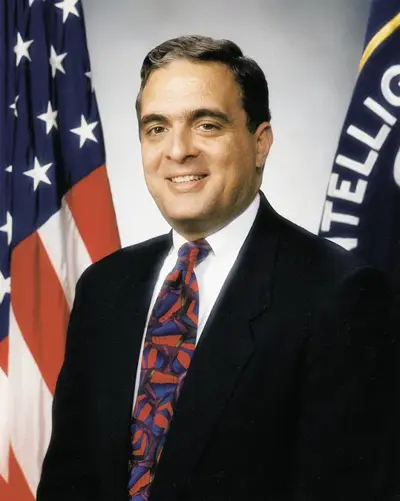
- Born: January 5, 1953
- Nationality: American
- Profession: Public Servant
George John Tenet is a former Director of Central Intelligence (DCI) for the United States Central Intelligence Agency as well as a Distinguished Professor in the Practice of Diplomacy at Georgetown University.
