
Context: He was right. Even the vaunted Southern Filibuster was broken by the strategy and tactics Johnson and Senator Humbert Humphry, the Floor Leader for the 1964 Civil Rights Bill.
LYNDON B. JOHNSON
(Lyndon Baines Johnson)
Context: President Johnson said this after the Washington Post reported that only one of three district swimming pools scheduled to open during the summer would be completed by Labor Day, July 19, 1966
Context: They did get divided and both staffs exacerbated the differences and past history between the two men. Kennedy ran against Johnson in the Presidential Primaries until he was assassinated in 1973.
Context: The President, on a tour of Southeast Asia, was warned by an aide not to shake hands in Thailand as physical contact was culturally innappropriate for Thais.
Context: On congressional criticism of his Vietnam policy:
Context: Until the end of Harry Truman’s presidency, republicans and other conservatives tended to accuse democratic presidents and other leaders are being too aggressive and belligerent in foreign policy. Republicans tended to oppose defense spending and a strong military. After WWII the isolationist republicans tended to become hawks. They favored extensive military spending and an aggressive foreign policy. Since then, they have generally attacked democrats as being too weak. President Lyndon Johnson was very much intimidated by being perceived as weak, and many attribute his expansion of the Vietnam War to his desire to avoid this right wing criticism.
Context: This was the country which for the first time in its history, the U. S. lost a war.
Context: President Johnson was referring specifically to Senator J. William Fulbright of Arkansas.
Context: The majority of the impetus of the Civil Rights movement came from religious organizations, but the Southern Baptists were generally not only unconstructive in eliminating segregation, but were supportive of racism and in some cases violence. The President was trying to turn them around.
Context: Halleck was in the President’s office when he made this call. Johnson could not get the Civil Rights Bill out of the Rules Committee in the House as the Chairman was a Southern racist. The only alternative was a Discharge Petition where more than half the House members sign a petition to bring the Act to the floor for a vote. But earlier in an attempt to maintain Republican Party Discipline, Halleck—the Republican Leader—had publicly announced that any Republican who signed a discharge petition would be expelled from the party. However Purdue University was in Halleck’s District and they had started a program in Space Engineering. Halleck went to visit Webb and Purdue received a huge set of NASA grants and contracts to build up their Space Program. Halleck called Republican House members and told them that he had changed his mind about the discharge petition which was signed and filed shortly thereafter enabling the House to vote in favor of the Civil Rights Act of 1964. In a number of the future years, the selection of the NASA Astronauts was so stringent that only Purdue graduates were able to be selected.
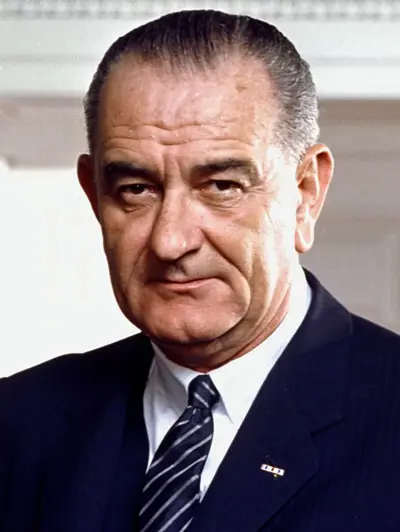
Lyndon Baines Johnson, often referred to by his initials LBJ, was the 36th president of the United States, in office from 1963 to 1969. He served as the 37th vice president from 1961 to 1963 and assumed the presidency following the assassination of President John F. Kennedy. A Democrat from Texas, Johnson was also a United States representative and later majority leader in the United States Senate. Johnson is one of only four people to have served, at various times, in all four federal elected positions.
Related Authors
