Homer Quotes
Zeus most glorious and most great, Thundercloud, throned in the heavens! Let not the sun go down and the darkness come, until I cast down headlong the citadel of Priam in flames, and burn his gates with blazing fire, and tear to rags the shirt upon Hectors breast! May many of his men fall about him prone in the dust and bite the earth!
Homer. The Iliad. Translated by W. H. D. Rouse, Thomas Nelson and Sons, 1938, p. 29.


He was warning the majority and blaming them for what was to happen. Ironically, at the end of the First World War, Germany was so harshly treated because the allies felt that the Germans had been aforewarned not only by others but by opposition Germans as well.


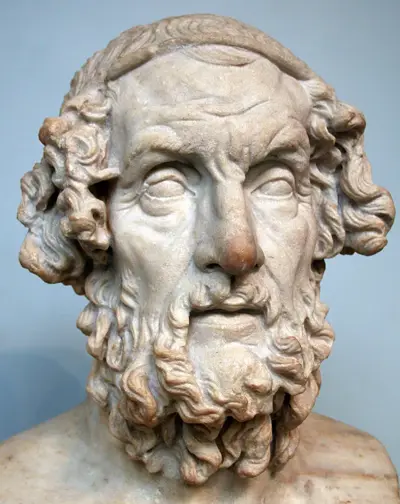
Homer (/ˈhoʊmər/; Ancient Greek: Ὅμηρος [hómɛːros], Hómēros) was the presumed author of the Iliad and the Odyssey, two epic poems that are the foundational works of ancient Greek literature. The Iliad is set during the Trojan War, the ten-year siege of the city of Troy by a coalition of Greek kingdoms. It focuses on a quarrel between King Agamemnon and the warrior Achilles lasting a few weeks during the last year of the war. The Odyssey focuses on the ten-year journey home of Odysseus, king of Ithaca, after the fall of Troy. Many accounts of Homer's life circulated in classical antiquity, the most widespread being that he was a blind bard from Ionia, a region of central coastal Anatolia in present-day Turkey. Modern scholars consider these accounts legendary.
