H. G. Wells Quotes
You aren’t quite serious in America yet. You haven’t got the war right under your chins.
At the time although the United States was providing material assistance to England, there was still the naïve belief that America could avoid becoming involved in WWII.
H. G. [Herbert George] Wells, 1866-1945, English Writer, Historian and Political Philosopher, Statement to Orson Wells, San Antonio, Texas, 1940
Sourced by: Eigen's Political and Historical Quotations


This quotation gives us a concept of the WWII home front effort where virtually everyone in American society was personally involved on a daily basis in the war. See also {637440}. This was so dramatically different from the home fronts for the wars in Afghanistan and Iraq where most of the American public had no direct contact with the war effort and was not called upon or even needed to do anything.


This statement is perhaps the greatest and most eloquent description of the United States exceptionalism and its behavior in WWII. Such a statement could only come from a non-American.


He was announcing the fall of France, and the start of the Battle of Britain. And that was their finest hour.


At that point the Japanese were losing the war on every front. It is not clear whether Hirohito would actually have done such and not tried to escape in the end, however he certainly expected his subjects, military and civilian to do so. That expectation and the behavior of the Japanese troops fighting to the death on many islands was a powerful factor in leading Truman, Marshall and other key American leaders to use the Atomic Bomb. See Marshall: {641063}

He was discussing the importance of the public’s perception that the values of the military are the same values as the nation holds.

He always appeared in a military uniform after that.


In the attack on Fort Wagner, the color bearer was killed as was the Commanding Officer, Colonel Shaw. Carney raised the flag and led the men up the sand wall into the Confederate midst. They were vastly outnumbered and then retreated. Carney was the first Black to win the Medal of Honor.
A Federal Naval flotilla was preparing to attack South Carolina Forts Beauregard and Walker in the area of Hilton Head and Port Royal. The navy took both forts the next day with their naval bombardment so powerful that the Confederate Rebels had to abandon both forts gaining a kind of revenge for the Confederate capture of Fort Sumter at the war’s beginning.

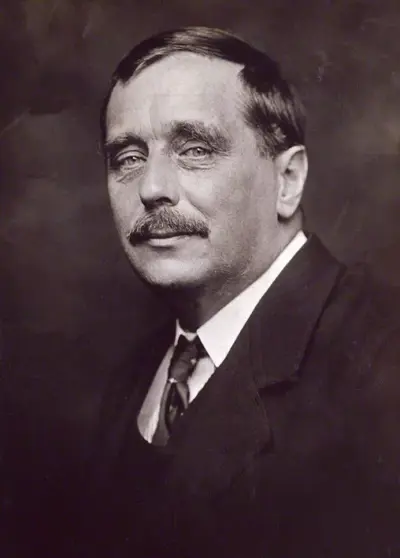
Herbert George Wells —known as H. G. Wells—was a prolific English writer in many genres, including the novel, history, politics, social commentary, and textbooks and rules for war games. Wells is now best remembered for his science fiction novels and is called a "father of science fiction", along with Jules Verne and Hugo Gernsback.[a] His most notable science fiction works include The Time Machine (1895), The Island of Doctor Moreau (1896), The Invisible Man (1897), and The War of the Worlds (1898). He was nominated for the Nobel Prize in Literature four times.
