William Bennett Quotes
Yes, Ronald Reagan did sleep through cabinet meetings—and deservedly so. They were incredibly tedious. I know; I was there.
William Bennett, Director, Office of National Drug Control Policy, U. S. Secretary of Education (Republican), Speech, Virginia Festival of Books, February 28, 2002
Sourced by: Eigen's Political and Historical Quotations

See {626594} for Polk’s negative view of delegation of any authority or responsibility.

He was responding to criticism that the media was bashing the President.


This was a subtle criticism of the Presidential Candidate Donald Trump whose only experience was in real estate development, reality TV, and promotion. This was in contrast to his opponent Hillary Clinton who had had vast experience at many roles and levels of government.


That is one view—the one tried the most frequently by Presidents who by their own estimates didn’t get a responsive civil service working to his priorities. Presidents like Teddy Roosevelt, Franklin Roosevelt, and Dwight Eisenhower and Lyndon Johnson had great cooperation from their civil servants; they instead appointed very competent people with strong senses of fairness and leading personnel. Ronald Regan tried both techniques. He used Wilson’s technique in his Education and Justice Department where there was slow-rolling and dissonance when his appointees tended to be ideologues with little or no outstanding professional competence in the fields they supervised. However, his military and State Department bureaucracies was very responsive to his appointees who were excellent leaders.

Lord Palmerston, John Henry Temple, had been the Foreign Minister. He had a style which like President George W. Bush, was perceived by foreign governments to be condescending and insulting. His policies were generally in line with the Prime Minister’s desires and the Queen’s but he was involved with one negative incident after another. England had sunk to it’s lowest public opinion assessment European had seen in years. The Queen was very distressed. Palmerstone a very senior and popular politician with a great deal of experience resented this young girl micromanaging his policies and statements. On several occasions he went ahead with a policy “forgetting” to clear it with the Queen in advance. To the degree the Queen had a political enemy, Palmerston was it. He controlled an important bloc of Prime Minister John Russell’s narrowly ruling party. When the Queen talked to the Prime Minister about firing the Foreign Secretary, Russell always pointed out that while there were ample grounds for firing, pragmatically he might not be able to hold a majority without the Foreign Secretary in the Cabinet. The Queen had great respect for Russell and did not wish the government to be in a crises so she repeatedly put up with Palmerston’s gaffs and insult. After a few years the political situation changed and Palmerston was no longer critical to the government and at his next incident the Prime Minister and the Queen agreed to terminate the Foreign Secretary. The quotation shows the Queen wanting the Prime minister to avoid embarrassing the man who had vexed her for several years. She was very “lady-like” and showed no interest in payback or vengeance. Many historians argue that if she were a male king, Palmerston would have been gone long before regardless of the cost as he had challenged the monarch. However, perhaps a female national leader does not have the instinct from the rutting male mammals that men seem to show when they deal with rivals. Palmerston was eased out of office with great praise and thanks from the Prime Minister and the Queen.

Alberto Gonzalez, White House Counsel and later Attorney General who was forced to resign and David S. Addington, Counsel to the Vice President, had come up with a novel view of the powers of the presidency. They argued that since the President is the Commander in Chief, in a war situation or intelligence gathering thereto, has the Constitutional responsibility for that function, he need not obey any laws of Congress as in the conduct of the war Congress would be impinging on the Constitutional separation of powers which itself was prohibited by the Constitution. The argument did not find any significant legal support but for a while the George W. Bush White House behaved as if this were the law, despite the fact that even in the American Revolution and the War of 1812 Congress passed laws regulating the conduct of the armed forces as is provided for in other parts of the Constitution. Yet even Goldsmith would allow the President some powers that many think are unconstitutional and/or belong to Congress. See {32436}.

On why the President should not be given the right to go to war without the approval of Congress:


Attacking FDR by pandering to anti-Semites and falsely claiming that a Jewish financier, Bernard Baruch ran the government: The Priest was the right wing demagogic radio host of his day. Virulently anti-Semitic and anti-Black, he was threatened with excommunication by the Catholic Church, which finally ordered him to cease us weekly radio show and stop the political hate.

He had been offered a Cabinet position in Washington. He had been a respected judge in Ohio and was only tangentially involved with politics. What he did see of it he did not like. However, others pressed upon him his duty to help the country and he took the position. But he was never comfortable or even very skilled and the political end of Cabinet service but he was extremely skilled at the administrative and policy making aspect. Theodore Roosevelt personally selected him to be his successor and Roosevelt get him elected. Even when he was President, he rarely enjoyed it and was not very good at the political end of things which caused Roosevelt to be disappointed and then campaign against Taft’s second term.


Many feel that this explains why he never ran for the Presidency even though he was the odds on favorite to win the Democratic Party Primary and the General Election.


Trump often used the phrase "Drain the swamp" in his campaigning to mean get ride of the establishment figures who had, for the most part, dominated politics, for decades. When he was elected, he had to appoint a cabinet, but when he did so, it was almost exclusivly made up of people who had been a part of the political and corporate establishment -- the swamp.

There are many factors that tend to make it very hard for Cabinit Secrretaries and other Presidencial appointments to control their agencies. They include inertia, the huge size of many agencies, existing laws, bureaucracies, and the techncial complexity of the work of the agency. Like a huge aircraft carrier, when they can make a change it takes a while for the change to occur and be noticable--typically more time than the average cabinet member is in office. This is much like CEOs of very large corporations.

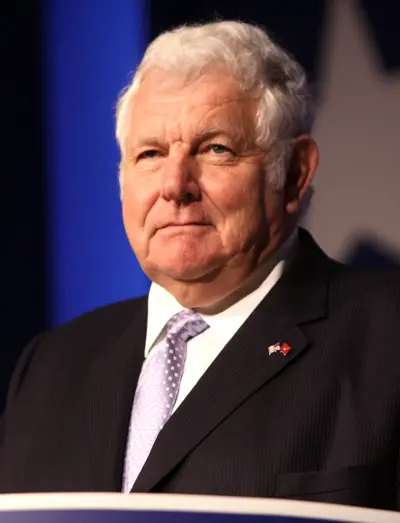
William John Bennett is an American conservative pundit, politician, and political theorist, who served as Secretary of Education from 1985 to 1988 under President Ronald Reagan. He also held the post of Director of the Office of National Drug Control Policy under George H. W. Bush.
