Thomas P.M. Barnett Quotes
Women waited 144 years before earning suffrage. If a mature, multiparty democracy was so darn easy, everybody would have one.
Barnett, Thomas P.M. Great Powers: America and the World After Bush. G.P. Putnam's Sons, 2009.


Woodrow Wilson had just finished speaking to the convention – see {638532}. This statement was thought be some to be insulting to the President who said he favored the right of women to vote, but did very little if anything to make that happen. Although Shaw was an ordained Methodist Minister, the Methodist Episcopal Church refused to allow her to preach because of her suffrage views.

First female presidential candidate & first divorcee to run for that office. The half to which she was referring were the females, who by many narrow laws were unable to participate in the intellectual and political life of the country. At the time, women could not even vote.


Hunt gave as an example Mary Smith of Stanmore. This quotation is very interesting in the history of women’s suffrage. Hunt was a strong advocate for Universal Suffrage (See {616653}.) At the time, even men had to be a taxpayer and own a sufficient amount of property to vote. Less than 20% of the population of Britain were allowed to vote. The argument at the time was that the husband would represent the family’s interest at the ballot box and there was no need for women to vote. But by facing parliament with the logical inconsistency of its position, he was able to make his point, although there were very few women like Mary Smith who were single and had the economic resources to qualify. Most widows remarried so even if they had economic resources, there was a man who could assume the then perceived role of head of the household.


Samuel Langhorne Clemens, 1835-1910


This was the last public speech that Lincoln made before he was shot.
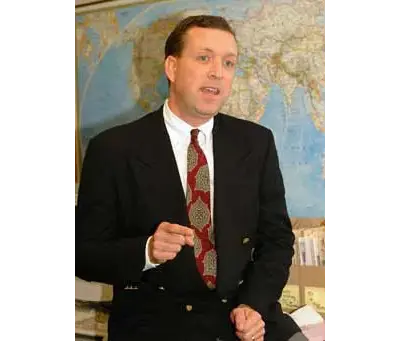
Thomas P.M. Barnett (born 1962) is an American military geostrategist and former chief analyst at Wikistrat. He developed a geopolitical theory that divided the world into "the Functioning Core" and the "Non-Integrating Gap" that made him particularly notable prior to the 2003 U.S. Invasion of Iraq when he wrote an article for Esquire in support of the military action entitled "The Pentagon's New Map" (which would later become the title of a book that would elaborate on his geopolitical theories). The central thesis of his geopolitical theory is that the connections the globalization brings between countries (including network connectivity, financial transactions, and media flows) are synonymous with those countries with stable governments, rising standards of living, and "more deaths by suicide than by murder". These countries form the Functioning Core. These regions contrast with those where globalization has not yet penetrated, which is synonymous with political repression, poverty, disease, and mass-murder, and conflict. These areas make up the Non-Integrating Gap.
