Soren Kierkegaard Quotes
Whoever thou art, whatever in other respects thy life may be, my friend, by ceasing to take part (if ordinarily thou doest) in the public worship of God, as it now is (with the claim that it is the Christianity of the New Testament), thou hast constantly one guilt the less, and that a great one: thou dost not take part in treating God as a fool by calling that the Christianity of the New Testament which is not the Christianity of the New Testament.
Kierkegaard, Søren. Kierkegaard's Attack Upon "Christendom," 1854-1855. Translated by Walter Lowrie, Princeton University Press, 1968, p. 59.


Some of the founding fathers were deeply religious men while others were not so. Some varied in their believes at different times of their lives, and a number were not very favorable towards orthodox religion. At the time, Roman Catholic and Protestant churches were persecuting other religions throughout Europe and people were still being killed for their “heretical” beliefs. Most important to some of them, kings and other monarchs whom they abhorred, all at the time claimed the Divine Right of Kings and the established churches were the most important support for monarchs. At the time most organized religions were opposed to freedom of conscience and certainly opponents of separation of church and state. American churches tended to take on American values but were never given the chance to dominate the American government they way many religions had in Europe and the rest of the world.
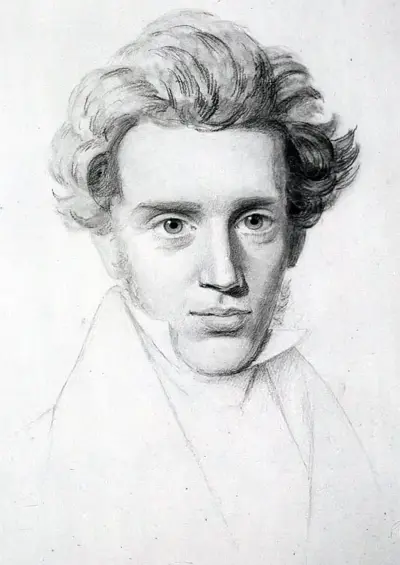
Søren Aabye Kierkegaard was a Danish philosopher, theologian, poet, social critic, and religious author who is widely considered to be the first existentialist philosopher. He wrote critical texts on organized religion, Christendom, morality, ethics, psychology, and the philosophy of religion, displaying a fondness for metaphor, irony, and parables. Much of his philosophical work deals with the issues of how one lives as a "single individual", giving priority to concrete human reality over abstract thinking and highlighting the importance of personal choice and commitment. He was against literary critics who defined idealist intellectuals and philosophers of his time, and thought that Swedenborg, Hegel, Fichte, Schelling, Schlegel, and Hans Christian Andersen were all "understood" far too quickly by "scholars".
