Thomas Becket Quotes
Who shall resist Anti-Christ when he comes if we show such patience towards the vices and crimes of his precursors? By such leniency, we encourage kings to become tyrants and tempt them to withdraw every privilege and all jurisdiction from the Churches.
Becket, Thomas. The Life and Letters of Thomas à Becket. Edited and translated by J. A. Giles, Whittaker and Co., 1846.

Jefferson wrote his friend that the New England clergy had opposed him because he would block their efforts to merge church and state. Inscribed in the rotunda of the Jefferson Memorial in Washington DC. The third sentence is often quoted without the first two.

This famous quotation has been attributed to Voltaire, 1694-1778, and French Philosopher, Denis Diderot, 1713-1784. Most quotation collections erroneously attribute it to Diderot in the version “Men will never be free until the last king is strangled with the entrails of the last priest.” Both Voltaire and Diderot used the quotation as did many others opposed to monarchy and the then repressive church hierarchies. But the origin of the famous phrase was with Meslier. When the priest died, three handwritten manuscripts were found written and signed by him in which he attacked religion in general and the church and the Bible in particular. His Testament was read by Voltaire and Denis Diderot among others and he was very influential in their development as opponents of organized religion.

As a result of Henry VIII establishing himself as the head of the Church in England and Ireland in place of the Pope, Henry’s heirs also became head of the Church. And that was the role that Queen Elisabeth had inherited in addition to the Crown. Many of those loyal to the Pope found most offensive the fact that a woman was making decisions for men and women on matters of faith. A Papal representative travelled with FitzGerald and probably helped him compose this document of which this is but 2 sentences. He may have drafted it completely. The Pope was a factor in many of the Irish rebellions against the English, and this caused great suspicion of all English Catholics whose loyalty to the Queen was in conflict with their loyalty to the Pope who was plotting for a Catholic takeover of England and Ireland.


Bin Laden made this statement warning of attacks on economic targets in the West in an audio tape released after the attack on the French oil tanker, the Limburg, off the coast of Yemen in October 2002


The Mamlukes were Turks from the Caucasus and Georgia who were taken prisoners of Genghis Khan, who sold them as slaves to the Ayyubid Sultan of Egypt. The Sultan trained them as soldiers, and eventually they became his palace guard. They actually took over Egypt at one point in the 13th century. When the Ottoman Turks took over the Middle East, they kept the Mamlukes as elite troops and they were a major political and military force in Egypt. Napoleon’s logic was that his Frenchmen had just as much right to control Egypt as did the Mamlukes.


The Pope was justifying his earlier excommunication of Holy Roman Emperor Henry IV who in turn excommunicated Pope Gregory.

This document was issued in the form of what today would be called a press release or a white paper. Altmark was the Lutheran seat of intellectuality and this document was part of a major Lutheran initiative to propagandize against the rising science of astronomy. The Catholics did the same and both religions saw astronomy as an enemy and evil. See {612384}
Ivan the Terrible. He was referring to himself as God’s Chosen One. He and the Church were aligned against the Nobles, whose lands Ivan wanted. He would execute hundreds of “traitors” every month. He even executed the families of his enemies in very cruel ways. He claimed to be “cleansing” the land of sinners in preparation for the coming judgment day, and the church backed him up on this. The Church gave him carte blanche to “punish” all sinners and his paranoia eventually got around to the church fathers themselves who became the final victims.

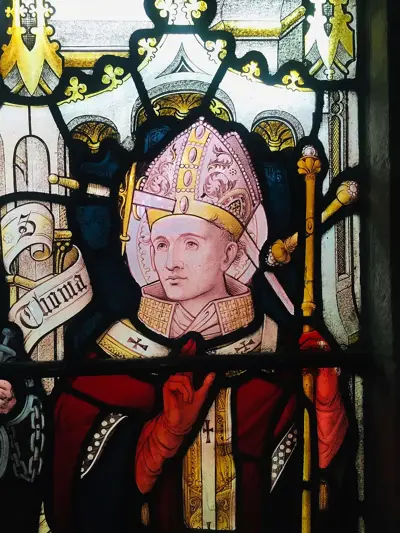
Thomas Becket (/ˈbɛkɪt/), also known as Saint Thomas of Canterbury, Thomas of London and later Thomas à Becket, was Archbishop of Canterbury from 1162 until his murder in 1170. He is venerated as a saint and martyr by both the Catholic Church and the Anglican Communion. He engaged in conflict with Henry II, King of England, over the rights and privileges of the Church and was murdered by followers of the king in Canterbury Cathedral. Soon after his death, he was canonised by Pope Alexander III.
