Al Gore Quotes
While I strongly disagree with the court’s decision, I accept it.
The Vice President had beaten George W. Bush by ½ Million Votes, but in the Electoral College the election was in doubt over many irregularities in Florida. Gore had wanted to have a hand count of all ballots that had not gone through the Florida voting machines and thus were not counted. The Bush forces opposed this in the courts, and in a highly partisan 5-4 decision, the U. S. Supreme Court overruled the Florida Supreme Court and stopped the inspection of the ballots leaving the actuality of the over 50,000 ballots unknown thus giving Florida to Bush assuring him of the Presidency. There was much tension as to whether the Gore forces would accept the Court’s decision, especially in the light of disclosures that the attorney son of one of the Bush justices was employed by the law firm representing Bush, and that Bush’s father had appointed another justice voting to make Bush president. A crisis was averted.
Albert Gore Jr., U.S. Senator (Democrat, TN), Vice President of the United States (Democrat, TN), Nobel Peace Laureate, Nationwide TV Address, December 14, 2000
Sourced by: Eigen's Political and Historical Quotations


One of the claimed advantages to the American system of primaries and a long Presidential campaign, it to have enough time and pressure to have each candidate be observed when things are not going smoothly so that the American electorate can determine his character when under pressure if things are not doing well.


Whithead’s view which seems intuitively right to most citizens, tends to be the one that the majority espouses but the minority opposes. At the time, the Republicans controlled the White House and there were a number of polarizing issues, where the Republicans could not obtain consensus and then decided. However, then the Democrats gained control of the White House and Congress the next year, it was the Democrats who claimed that they had to decide. The Republicans, now in the majority, argued that significant changes in America should not be made by narrow majorities and major issues should be tabled if there was no substantial majority. That was the position that the Democrats had espoused when they were in the minority.

This seems to be especially true in historical conflicts of nations and peoples.

At the time of the interview she had retired from the bench.


In the 2000 Presidential Election, Gore won the popular vote, but the electoral votes were so close that the winner depended on a single state, Florida. However, that state’s election process was poor and there were many irregularities and problems in vote counting and recounting. The Republican Secretary of State stated that the Republican candidate won, but the irregularities persuaded the Florida Supreme Court to order a recount. That decision was appealed to the Supreme Court which decided to stop the recount, giving the Presidency to Bush. All nine Supreme Court Justices were unhappy that they had to decide a case which determined who the President would be, but if they had refused to hear the case, the raw politics of Florida would determine the President. Stevens wrote this quotation in his dissent, and ironically it was about the only thing that the nine justices all agreed to—that the nation’s confidence in the Supreme Court and the legal system was the loser. There was no way for the court to win, unless they could have mustered an overwhelming majority for one side or the other. That proved impossible, so all the justices tried to make the best of a bad situation in which they had been placed.


He came under much criticism for his aggressive recruiting of high school players, and at most press conferences reporters would ask pointed questions about his methods and ethics. This was his stoch reasonse.


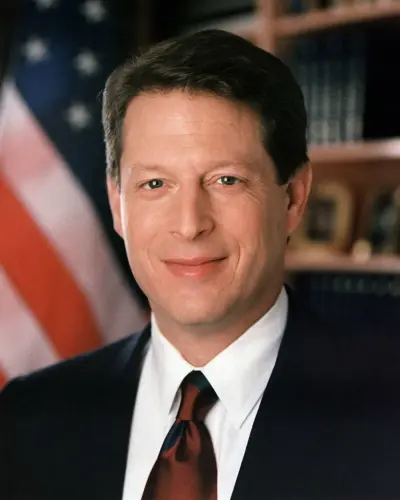
Albert Arnold Gore Jr. is an American politician and environmentalist who served as the 45th vice president of the United States from 1993 to 2001. Gore was Bill Clinton's running mate in their successful campaign in 1992 and the pair were re-elected in 1996. Near the end of Clinton's second term, Gore was selected as the Democratic nominee for the 2000 presidential election but lost the election in a very close race after a Florida recount. After his term as vice-president ended in 2001, Gore remained prominent as an author and environmental activist, whose work in climate change activism earned him (jointly with the IPCC) the Nobel Peace Prize in 2007. In 2008, Gore won the Dan David Prize for Social Responsibility.
