John Dewey Quotes
Where there is a complete manifestation of the Malthusian theory of population, friendliness develops with great difficulty to the point of active effort to relieve suffering; where further increase in population means increase in severity of the struggle for subsistence, aggressive benevolence is not likely to assume large proportions. On the contrary, when the cutting off of thousands by plague, or flood, or famine means more air to breathe and more land to cultivate for those who remain, stoic apathy is not hard to attain.
Malthus wrote about the consequences of overpopulation. See{606180}, {606181}, {493953}.
John Dewey, 1859-1952, Philosopher & Educator, Comment on the massive starvation occurring in China after the revolution ending the militaristic Manchu Dynasty, Quoted in J. O. P. Bland, China, Japan and Korea, 1921
Sourced by: Eigen's Political and Historical Quotations


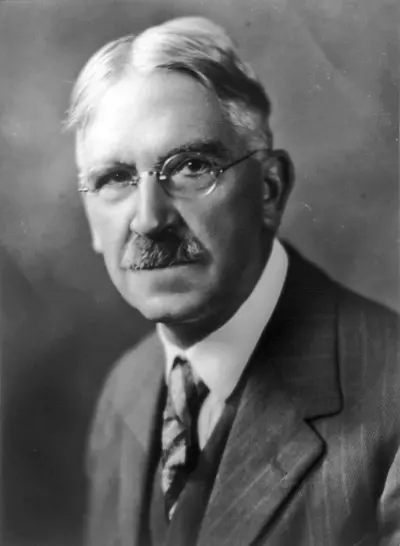
John Dewey was an American philosopher, psychologist, and educational reformer whose ideas have been influential in education and social reform. He was one of the most prominent American scholars in the first half of the twentieth century.
