Peter Singer Quotes
When you look at food as an ethical issue in the Christian tradition, you don't find very much about it. You don't find, as you do in the Jewish or Islamic or Hindu traditions, a lot of restrictions saying you can eat this but you can't eat that.
Singer, Peter. "The Ethics of Eating." Interview by Laura Sheahen. Beliefnet, 2006.


al-Mansur Abu Ali. Despite the Koranic prohibition of alcohol, Egyptians at the time drank a wine made of fermented raisins and honey. Previous Caliphs had not strongly attempted to enforce the religious law. The Caliph’s Christian physician, Ibn Anastas, pronounced wine a healthy drink and the population was delighted. He soon died, and the Caliph, in an attempt to return to Muslim fundamentalism, banned all alcohol. He had great difficulty enforcing his prohibition, and finally resorted to banning the sale of the favorite wine making ingredients.

The Muslim Brotherhood had won the Presidency in the first Egyptian democratic election shortly after the ouster of Mubarak when they were the only party that was organized. However, after one year of government, their performance was so bad that critics like El Baradei offered strong public criticism—especially of the preoccupation with Islam with little government attention given to freedom, human rights, and the economy which was in terrible shape. This was the focus of the pointed article title. A few days after this article was published there was an insurrection of huge crowds of Egyptians and the Muslim Brotherhood President Morsi was forced to resign.


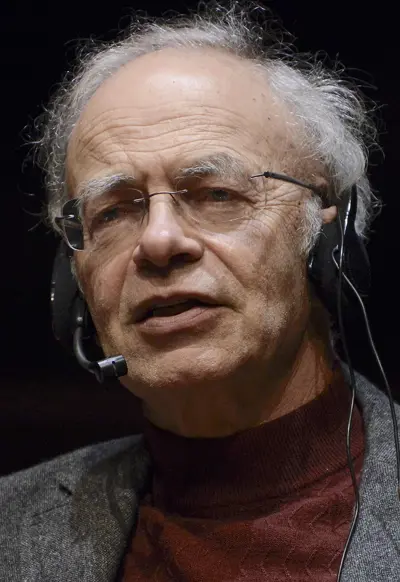
Peter Albert David Singer AC is an Australian moral philosopher, currently the Ira W. DeCamp Professor of Bioethics at Princeton University. He specialises in applied ethics and approaches ethical issues from a secular, utilitarian perspective. He is known in particular for his book Animal Liberation (1975), in which he argues in favour of veganism, and his essay "Famine, Affluence, and Morality", in which he argues in favour of donating to help the global poor. For most of his career, he was a preference utilitarian, but he stated in The Point of View of the Universe (2014), coauthored with Katarzyna de Lazari-Radek, that he had become a hedonistic utilitarian.
