Pius XI Quotes
When there is question of saving souls, or preventing greater harm to souls, We feel the courage to treat with the devil in person.
Pius XI, 1857-1939, [Achille Ratti], Roman Catholic Pope, Speech to the students of the Mondragone college, May 14, 1929
Sourced by: Eigen's Political and Historical Quotations

This is an example of one of the reasons he was called “Gregory the Great”. At a time when most church leaders were rigid ideologues, this pope realized that many pagan customs and traditions were embedded in Christian society and it would not successful to try and ban all the pagan customs immediately. So he urged starting where the people were and making gradual changes to finally reach a more Christian celebration pattern. Not only was he successful, but somehow, his strategy was consistent with modern behavior change psychological principles.


At that time, and in much of the world today, religious preaching and those who do it are licensed by the state. Lucian’s response was one of the first statements that governments and temporal powers endorsement was not required, nor was any formal ordination or grant of authority from a formal church as existed among the pagans of the time where the religion was seen as another extension of the state. Even in America there is some ambivalence on this point. Many religions require not only training but a grant of authority from the religious hierarchy. Others such as some Baptists and many Protestant Fundamentalist groups believe that no specific authority is needed other than the “calling of god.” Lucian was apparently the first person to claim the authority as an individual. He was burnt alive for his position. There is a second Saint Lucian. To distinguish the latter is often referred to as Saint Lucian the Syrian.

The Roman Catholic Church then maintained that salvation was dependent upon obedience to the Pope in all things civil and religious. See {595166} for the way that the Church at the time allowed some authority to civil authorities.


This quotation, 500 years later, would be used by American anti-Catholics to justify their antipathy to the Catholic Church. This was about a most undemocratic statement about the common man and his capabilities which was completely counter to the American view. The fact that it was 500 years past or that many American Catholics did not believe it or that even if they did, it was restricted to matters of theological faith, was not considered by the Know-Nothings and others.


The Pope was justifying his earlier excommunication of Holy Roman Emperor Henry IV who in turn excommunicated Pope Gregory.


See {611241}, {611246}, {611442}. While the issues with Cromwell were essentially political, there were substantial theological and cultural issues between the Quakers and other protestant sects which even extended across to the New World. See {612011}


Those who argue that the United States is a Christian country often point to this quotation to illustrate the fundamental religious purpose to the Massachusetts Colonies
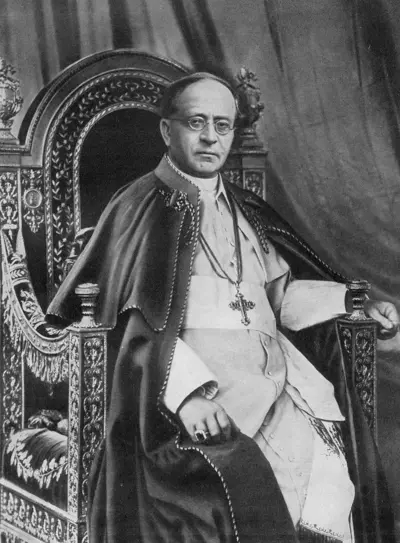
Pope Pius XI (Italian: Pio XI), born Ambrogio Damiano Achille Ratti, was head of the Catholic Church from 6 February 1922 to his death in 1939. He was the first sovereign of Vatican City from its creation as an independent state on 11 February 1929. He took as his papal motto "Pax Christi in Regno Christi," translated "The Peace of Christ in the Kingdom of Christ."
