Julius Streicher Quotes
When the Jews speak of humanity, they mean only the totality of Jews.
Bytwerk, Randall L. Julius Streicher: Nazi Editor of the Notorious Anti-Semitic Newspaper Der Stürmer. Cooper Square Press, 2001.


These kinds of inflammatory sermons are delivered with the approval of the king and royal family who crack down on any cleric who preaches what they do not approve of.

This quotation was uncovered in 2010 when more of the Nixon White House tapes were released. Nixon tended to have the worst stereotyped view of all minority groups. At one level, Nixon was just being political by not inviting any Jews except supporters. However, he did not maintain that same criterion regarding Protestants, Catholics, or other religious groups. The reality was that Nixon was generally very anti Semetic but saw some Jews as “good Jews” like his Secretary of State Henry Kissinger and Golda Meir, the Israeli Prime Minister in whose honor the dinner was being held. See {621141} as an example.


The Turks had massacred the vast majority of their Armenian population, and treated the Greeks badly killing and them many of them from territories the Ottoman Turks had conquered. Jews fared better but were 2nd class citizens. Bristol was the American State Department’s senior official and was very “understanding” of the murders and ethnic cleansing despite the fact that President Wilson and most American politicians were very opposed to the Turkish massacres. See {620614} and {620599} . Two factors makes this quotation very significant. First, at the time the State Department was not really under the control of either the President or the Congress. It was not rare for the Department to have its own policies and implement them. This began to change in WWII and FDR exercised much more control than previous presidents since Theodore Roosevelt. The second factor is that there were many racists throughout the State Department—Bristol was only one. There was little concern for minorities’ welfare and the emphasis was on commerce. See {620600} Even in Truman’s administration, the President had massive opposition from the State Department for his policy of recognizing the State of Israel. Today, this kind of racism in the State Department is very rare, and human rights has been one of their major concerns. There were many changes in 75 years.

Ernestine Louise Polowsky

This quotation was used by the Lyndon B. Johnson 1964 Campaign as: “We represent the majority of the people in Alabama who hate niggerism, Catholicism, Judaism, and all the isms of the whole world.” So said Robert Creel of the Alabama Ku Klux Klan. He also said, “I like Barry Goldwater. He needs our help.” The second statement was made at a different time.


Vladimir Lenin. Despite Lenin’s abhorrence of anti-Semitism, there were any other Russians for whom it was normal. After Lenin’s death, Stalin and his henchmen used anti-Semitism to divert attention from the Communist Party’s failure to meet its economic and other goals.


In his early years, Stalin was a strong opponent of Anti-Semitism ({627514}) but he felt he needed to make a pact with Nazi Germany—the Hitler-Stalin Pact. In meeting with Nazi Foreign Minister Ribbontrop, Stalin as a quid pro quo promised to get rid of “Jewish Domination” (which never existed but there were many Jews in positions) among officials and intellectuals. He then fired his Jewish Foreign Minister Litvonof and replaced him with Vyacheslav Molotov to whom he have this instruction. This was the first major official Anti-Semitism of the Soviet Union but it continued thereafter. See {636526} & {636527}.

Artukovic was later convicted as a war criminal.

According to Bauer and his anti-Semitic followers, the problem with the Jews was Judaism

See {588181} for more about the Rally. Kuhn followed the Nazi Party line that claimed America was controlled by Jews. At the same meeting he referred to President Franklin Delano Roosevelt as “President Franklin D. Rosenfeld using a typical Jewish name. Many Nazis believed that the President was a Jew who had changed his name.


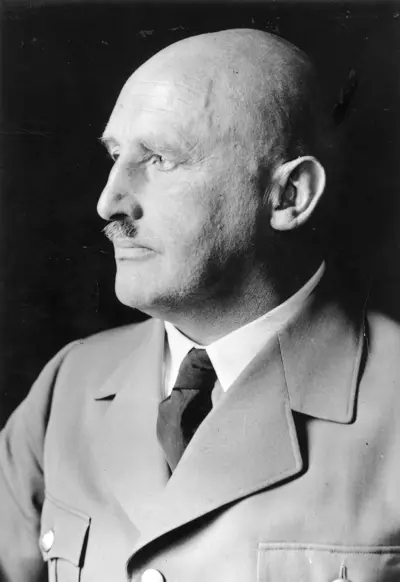
Julius Streicher was a member of the Nazi Party, the Gauleiter (regional leader) of Franconia and a member of the Reichstag, the national legislature. He was the founder and publisher of the virulently antisemitic newspaper Der Stürmer, which became a central element of the Nazi propaganda machine. The publishing firm was financially very successful and made Streicher a multi-millionaire.
