John Kenneth Galbraith Quotes
When the Department does respond to telegrams it is invariably to recommend evasion of issues that cannot be evaded.
The ambassador complained to the President about the State Department's lake of response to his cables:
John Kenneth Galbraith, 1908–2006, Economist, U. S. Ambassador to India (Democrat), Letter to John F. Kennedy
Sourced by: Eigen's Political and Historical Quotations


The United States has often staffed its foreign mission with foreigners to save money or obtain specific skills.


In a famous debate with Congressman Henry De La Flood (Democrat, VA), the issue was the common practice of hiring foreign nationals to represent the United States in many foreign posts, since their services could be obtained much less expensively than the costs of sending Americans abroad:. See President Millard Fillmore's 1856 campaign speech.

He was referring to the President of Egypt in the midst of the Egyptian soft revolution of 2011. Wisner had been asked by the President to tell the corrupt and dictatorial President of Egypt to step down quickly. A few days later, Wisner gave a speech calling for the 30 year Egyptian dictator to finish out his term so he could “steer the changes”. He claimed that he was not speaking for the administration in this speech but it was a personal view. However, the speech created much world confusion as to what the US administration policy actually was. The quotation illustrates one of the problems of conducting diplomacy in a free democracy. A president asks a citizen to represent him; he does, and then turns around and undercuts the very position he was supposed to take. In many counties such an disloyal act would be considered treason but in America there is nothing the administration could do about it, other than to say that the Munich speech was contrary to US policy.

This advice has been taken by many elected Presidents and Prime Ministers in a democracy beginning a new administration. Essentially it is delay and “kick the can down the road”.

Islamic Religious Fundamentalist Terrorists in Algeria had kidnapped over 100 Western Hostages including some Americans. One of the terrorist’s “demands” was for the release of convicted murderers and terrorists in the United States. The official policy which she stated was not totally accurate. On several occasions, U. S. Officials or third parties representing them had “unofficially” negotiated with terrorists. In many cases this was a tactic to buy time and military action followed and in other cases unofficial ransoms were actually paid. The United States has had to contend with this problem with Islamic Terrorists and Pirates since the Thomas Jefferson Presidency when he argued against John Adams who wanted to pay the tribute while Jefferson preferred military action.
See {630440} for an earlier English human relations statement of the idea.


The cost of policy makers being ignorant about the country for which they were making policy has been at best unintended and unexpected consequences of our policy when implemented or at worst policy failure a in the Libyan Intervention, the Iraq invasion, and the inadvertent giving the green light to the Argentinian government to invade the Falkland Islands.


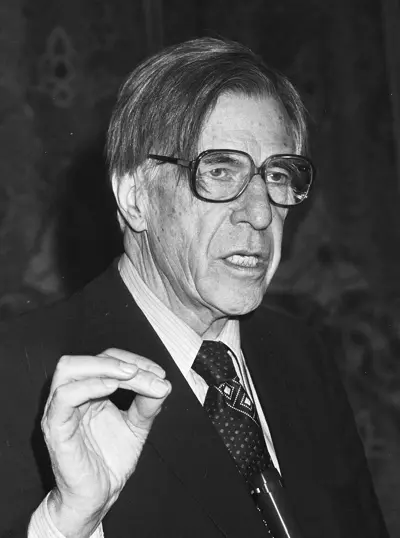
John Kenneth Galbraith OC, also known as Ken Galbraith, was a Canadian-American economist, diplomat, public official and intellectual. A leading proponent of 20th-century American liberalism, his books on economic topics were bestsellers from the 1950s through the 2000s. As an economist, he leaned toward post-Keynesian economics from an institutionalist perspective.
