Gilbert K. Chesterton Quotes
Whatever else we may say of our own age, for good or evil, nobody is likely to call it an Age of Reason.
Chesterton, G. K. The Illustrated London News.


Much of modern science involves non-intuitive concepts that can rarely if ever be discovered using common sense. It was hard enough for most people to accept the notion of an infinite number, but now we know that there are many infinite numbers and they are all different form one another. Darwinian thinking was contrary to most learned thought of the day, and even much public opinion today. Even Albert Einstein had to struggle to comprehend the findings of Quantum Mechanics which are very non intuitive—one object can be in two different places at the same time. Meanwhile, most people are totally unaware that the world around is does not correspond to normal human intuition and common sense. Yet these are the same and only tools that we continue to use in making decisions about our society. And the fundamental truths of yesterday, the foundation of past thinking and glory, are the naïve simplifications and errors of today and become the superstitions of tomorrow.


Leading politicians thought Europe were all having this problem with he wave of right-wing populism that had developed over the combination of terrorism, immigration, and globalization. At the same time in the United States all the major Republican Candidates for the Presidential Nomination had the same difficulty, and Donald Trump beat them all despite his irrational presentations which were in many cases fabrications. In the general election where a song minority could not win the election as in the primaries, he began to falter but his success with his irrational, anti factual, but demagogical approa.ch garnered many voters. Both in Europe and America the demagogues did best with poo9rly educated , who were intellectually and culturally far from The Enlightenment


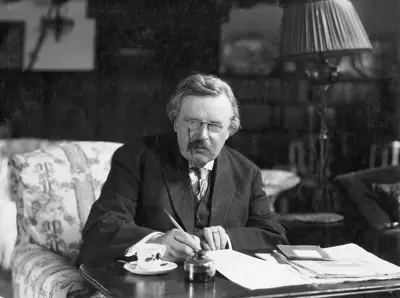
Gilbert Keith Chesterton KC*SG was an English writer, philosopher, lay theologian, and literary and art critic. He has been referred to as the "prince of paradox". Time magazine observed of his writing style: "Whenever possible Chesterton made his points with popular sayings, proverbs, allegories—first carefully turning them inside out."
