Ron Paul Quotes
What we need to do is not only live within our means, but start paying down the deficit, and offer an opportunity at least for the next generation to get out.
Paul, Ron. Republican Presidential Primary Debate. Fox News, 5 May 2011.


This is a particularly interesting historical quotation. It shows that when FDR was first elected, he had a classic view of deficit spending. However, above all, Roosevelt was a pragmatist and not an ideologue. Faced with the Great Depression that was not getting much better, Roosevelt turned around, changed his mind and policy about deficits and embarked on the “pump priming” approach of injecting substantial Federal spending into the economy and accepting the deficits in order to improve the situation which had been stagnant. FDR’s new policy staved off total disaster, but few remember that his great success was a total reversal of his earlier views.

Almost every major corporation that is growing must borrow money to finance the growth. There is a great temptation to do this continuously, as if all works out the borrowed money is paid back and the nation has grown. However, not every investment succeeds, and when they do, few nations will take the growth and save it for a future date when a national investment does not work out as well as hoped. Gradually national debt as a proportion of the economy gets larger and larger and it makes mew investments more and more difficult to succeed because of the higher rates of interest that must be paid. Every modern country must find a balance. Those that do not can have a financial disaster such as Greece in the early part of the 21st century.


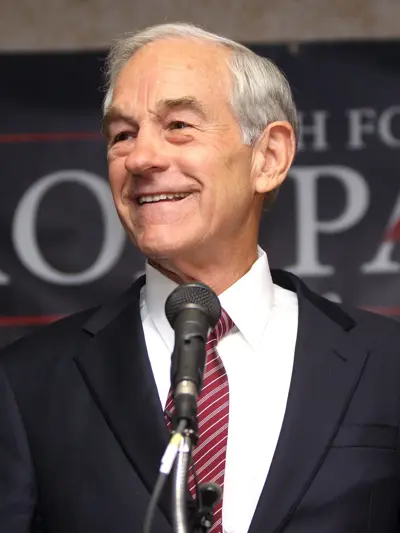
Ronald Ernest Paul is an American author, physician, and retired politician who served as the U.S. Representative for Texas's 22nd congressional district from 1976 to 1977 and again from 1979 to 1985, and for Texas's 14th congressional district from 1997 to 2013. On three occasions, he sought the presidency of the United States: as the Libertarian Party nominee in 1988 and as a candidate for the Republican Party in 2008 and 2012. A self-described constitutionalist, Paul is a critic of the federal government's fiscal policies, especially the existence of the Federal Reserve and the tax policy, as well as the military–industrial complex, the war on drugs, and the war on terror. He has also been a vocal critic of mass surveillance policies such as the USA PATRIOT Act and the NSA surveillance programs. He was the first chairman of the conservative PAC Citizens for a Sound Economy, a free-market group focused on limited government, and has been characterized as the "intellectual godfather" of the Tea Party movement, a fiscally conservative political movement that is largely against most matters of interventionism.
