Tariq Ramadan Quotes
What we have within the Sunni tradition is this clash between the literalists and all the other trends and the Salafi movement, that are very much acting on the ground and using the popular sentiment to act against the West.
Ramadan, Tariq. Islam and the Arab Awakening. Oxford University Press, 2012.


This is an interesting quotation as it shows that there were opponents of literal interpretation of the Bible in the 17th century, and that they were among the leading men of the day. The argument that the Bible has divine inspiration but was written by men and should not be taken literally, has been made since the Ancient Jews received the Bible.

The Grammar Curmudgeon. This is one side of a fundamental argument within America as to the Constitution. The other side argues that the original intent of the Founding Fathers should prevail. That their principles are what has made America great, and we do not want to deviate from those. In determining Constitutionality, it is the original intent that should prevail even if the issues are ones of which the founding fathers had no inkling such as the ability of a nuclear power to destroy much of the nation before Congress could be called into session or that police could use geo-positioning devices to track the movement of citizens. Or that women could prove themselves the equal of (or superior to) in intellectual pursuits and would want to participate in politics and policy making.


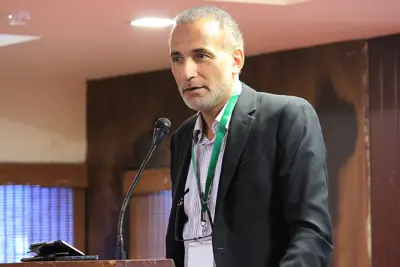
Tariq Ramadan is a Swiss Muslim academic, philosopher, and writer. He was a professor of contemporary Islamic studies at St Antony's College, Oxford and the Faculty of Theology and Religion, University of Oxford, but as of 2018 is taking an agreed leave of absence. He is a visiting professor at the Faculty of Islamic Studies at Hamad Bin Khalifa University in Qatar, and the Université Mundiapolis in Morocco. He is also a senior research fellow at Doshisha University in Japan. He is the director of the Research Centre of Islamic Legislation and Ethics (CILE), based in Doha. He is a member of the UK Foreign Office Advisory Group on Freedom of Religion or Belief. He was elected by Time magazine in 2000 as one of the seven religious innovators of the 21st century and in 2004 as one of the 100 most influential people in the world and by Foreign Policy readers (2005, 2006, 2008–2010, 2012–2015) as one of the top 100 most influential thinkers in the world and Global Thinkers. Ramadan describes himself as a "Salafi reformist".
