Raul Alfonsin Quotes
What we have to do in Latin America is learn to raise our own national and regional banners so that our subcontinent doesn't become the ideological battleground of the two superpowers.
Raul Alfonsin, President, Argentina (Radical Civic Union Party), Quoted in Newsweek, March 10, 1984
Sourced by: Eigen's Political and Historical Quotations


After the economic & power collapse of the Soviet Union, the United States was the only remaining superpower. Givern Russia's diminshed capability and many Americans still carrying resentments about the Cold War, America's foreign policy and diplomacy did not treat Russia as if they were a very important power in the world. Puten greatly resented the fact that Russia was no longer considered or treated like a world power, Russia had a nuclear arsenal and a total delivery system what was in the same destructive potential class as the United States. There were many Russiabs who had similar resentments and Putin sert out to adopt policieis and practices that would force the United States and the other nations to consider them with more dignity, respect and consdideration. This was a typical statement of the period when he was "stoking the fires of Russian resentment.


The strong American instinct toward unilateralism, narrowly defined self-interest, and operating under the banner of the United Nations has its traditional roots.
Adams was not only generally wary of involvement in foreign intrigues but was suspicious of the Greek war of independence in that the Greeks were no more committed to democracy and freedom than the Ottomans were.


This and other statements he made about the breakup of the Russian empire, together with his actons reagading foreign affairs, led many Western observers to think that Putin was trying to build up Russia to be amajor World Power as it was relatively recently. Also see Quotation 644183 under Related Quotes foir a more explicit statement,

This was more than a decade after the fal of the Soviet Union.

He was not attributing this to any particular polices or the United States. The U. S. had the so large and was such a force on so many areas that most things the U. S. did would potentially affect every oither nation in the world. There was almost no situation in the world in which the U, S, position and extent of invlovement would not affect the countires involved. At the same time the rapidly accelerating technological change that is changine everything is being led by United States scientists, technologists, and corporations. So if technological change was destabilizing which it was in most societies including America's the United States was the driver. And then, the Presidential election victory of Donald Trump, who had a a stated practice being inconsistant on many things, of aggressivly looking for new ways of doing things in American politics (and had been an exemplar during the campaign), and a strong reluctance to have broad general policies that woild guide his policies and intentions. American politics was changing more than usual with both major political parties were going through major reinvntions and struggles to define themselves. The United States was, moreso than any other country, culturally used to rapid change througout the society and still thriving. But for most other cultures, these things all together could determine the perception of stability and the lac k thereof in most of the world. But even the methods of dealing with climate change which is a source of anxiety for most nations, realsitically depends on what the United States will do or not do and that lack of certainty or even liklihood to prediuct affects people the world over.


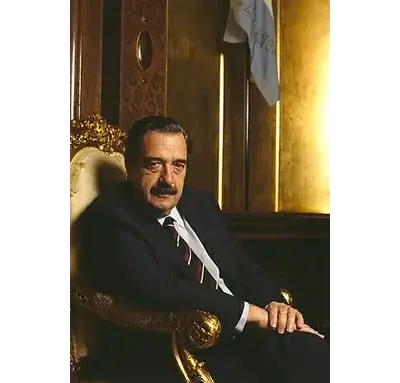
Raúl Ricardo Alfonsín Foulkes was an Argentine lawyer and statesman who served as President of Argentina from 10 December 1983 to 8 July 1989. He was the first democratically elected president after more than seven years of military dictatorship, and is considered the "father of modern democracy in Argentina". Ideologically, he identified as a Radical and a social democrat, serving as the leader of the Radical Civic Union from 1983 to 1991, 1993 to 1995, 1999 to 2001, with his political approach being known as "Alfonsinism".
