Andrew Young Quotes
What we forget is that African Americans made the largest contribution to America, economically, before the Civil War of any sector of society. I read that the railroads were worth about $2 billion, but slavery was a $3 billion asset.
Young, Andrew. Walk in My Shoes: Conversations between a Civil Rights Legend and his Godson on the Journey Ahead. Palgrave Macmillan, 2010.


While this assessment was true up until the 1980s. By the 21st century there were almost no serious historians who thought that the motivation of the Confederate States for the Civil War was anything but slavery and the economic impact that abolition might bring. However, one of your advantages having this collection of historical quotations is that you can see for yourself why the Southern states say they were seceding. This following are four of the official secession resolution documents. Read these and you will see that all the claims that there were other major reasons for secession are just attempts to make the Confederacy a little less brutal and greedy. See {621371}, {619793}, {621372}, {621375}

There was little thought of emancipating slaves or their value to the South by the senior officers of the Union Army at the beginning of the war. The Secretary of War however changed that. See {629184}.

Essentially, the case of moral hazard was made against paying the slave owners. Lincoln took a pragmatic approach. However, not only was Northern opposition too strong for this proposal, but the Southern slave holders would never agree to selling their slaves. What Lincoln and most “pragmatic” Northerners did not realize is that even if the slave owners would get a fair market price for the slaves, they would be left with land and no way to work it. Their families would have no servants. They might have to work themselves like Northern farmers did, and their entire standard and style of living would be destroyed. Their sons were not well educated as many Northern young men were and were brought up to be gentlemen, politicians, and occasional soldiers—not work with their hands. They could not compete. And the slaveholders were right as the whole history of Reconstruction and backwardness demonstrated for more than 100 years.
loyalty oath to the King of England His “Ethiopian Regiment” was the first Black military regiment in North America. Soon after, Rhode Island organized a Black military unit—see {613949}.

This Civil War recruiting poster was described by the Free Library of Philadelphia as “Civil War recruitment print targeting African Americans by evoking the freedoms granted by the Emancipation Proclamation. Depicts a montage of symbolic scenes centered around an African American Union soldier triumphantly holding up a sword and an American flag with the banner "Freedom to the Slave." He stands near broken shackles upon a tri-color flag adorned with a coiled snake. The flag is tugged upon by one of three joyous slaves freed by an African American soldier. Other scenes depict an African American man reading a newspaper on a rocking chair near a plow and child, African American children entering a "Public School" near a church, and a regiment of "U.S. Colored Troops" marching across a battlefield strewn with dead bodies.”


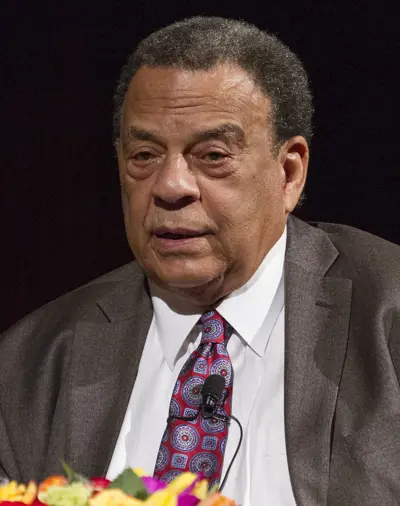
Andrew Jackson Young Jr. is an American politician, diplomat, and activist. Beginning his career as a pastor, Young was an early leader in the civil rights movement, serving as executive director of the Southern Christian Leadership Conference (SCLC) and a close confidant to Martin Luther King Jr. Young later became active in politics, serving as a U.S. Congressman from Georgia, United States Ambassador to the United Nations in the Carter Administration, and 55th Mayor of Atlanta. Since leaving office, Young has founded or served in many organizations working on issues of public policy and political lobbying.
