John Gresham Machen Quotes
What is the relation between Christianity and modern culture; may Christianity be maintained in a scientific age? It is this problem which modern liberalism attempts to solve.
Machen, J. Gresham. Christianity and Liberalism. The Macmillan Company, 1923, p. 6.


The Founding Fathers represented a wide range of religious beliefs from orthodox Christians to Agnostics and Atheists. Most considered themselves Christian, but having studied the terrible results of European religious dissention in Government were careful to keep government and religion separate. In New York City, for example, when George Washington was first inaugurated as President, there was no religious ceremony in the government buildings. However, the President and all the Congress then went to Trinity Church close by and had a religious service. The earliest example of separation of church and state was a separation of official religion—not an elimination of religion.


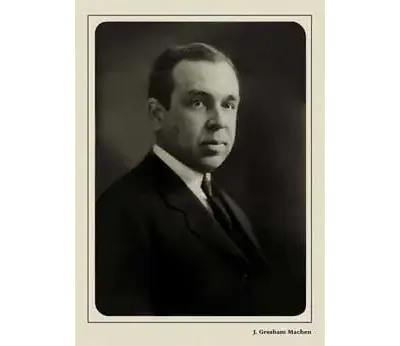
John Gresham Machen (/ˈɡrɛsəm ˈmeɪtʃən/; 1881–1937) was an American Presbyterian New Testament scholar and educator in the early 20th century. He was the Professor of New Testament at Princeton Seminary between 1906 and 1929, and led a conservative revolt against modernist theology at Princeton and formed Westminster Theological Seminary as a more orthodox alternative. As the Northern Presbyterian Church continued to reject conservative attempts to enforce faithfulness to the Westminster Confession, Machen led a small group of conservatives out of the church to form the Orthodox Presbyterian Church. When the northern Presbyterian church (PCUSA) rejected his arguments during the mid-1920s and decided to reorganize Princeton Seminary to create a liberal school, Machen took the lead in founding Westminster Seminary in Philadelphia (1929) where he taught New Testament until his death. His continued opposition during the 1930s to liberalism in his denomination's foreign missions agencies led to the creation of a new organization, the Independent Board for Presbyterian Foreign Missions (1933). The trial, conviction and suspension from the ministry of Independent Board members, including Machen, in 1935 and 1936 provided the rationale for the formation in 1936 of the OPC.
