Richard P. Feynman Quotes
What is necessary for 'the very existence of science,' and what the characteristics of nature are, are not to be determined by pompous preconditions, they are determined always by the material with which we work, by nature herself. We look, and we see what we find, and we cannot say ahead of time successfully what it is going to look like. ... It is necessary for the very existence of science that minds exist which do not allow that nature must satisfy some preconceived conditions.
Feynman, Richard P., Robert B. Leighton, and Matthew Sands. The Feynman Lectures on Physics, Volume I. Addison-Wesley, 1963, p. 16-2.


At the time, this was a very political speech. Racism was rife in Germany and was being introduced into Italy by the Fascist government. Xenophobia was prevalent throughout Europe as WWI hatreds had been inflamed by the politicians. Bohr’s speech was considered a major attack on Fascism.


This quotation from 1888 is apropos many of the major scientific advances which are counter-intuitive. Relativity was one; another was Quantum Mechanics where we have to learn to accept the fact that something can be in two (or more) places at once or that the exact same forces acting on an object can produce more than one result. Most non-scientists would see these as absurd, but they are basic characteristics of modern physics.


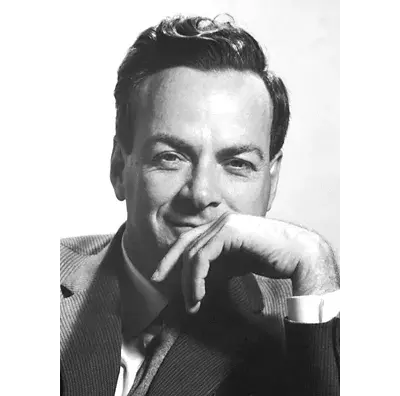
Richard Phillips Feynman was an American theoretical physicist and Nobel Prize winner who made significant contributions to quantum mechanics, quantum electrodynamics, and particle physics. He's known for his work on the Manhattan Project, developing Feynman diagrams, and explaining the interactions between light and matter. While studying for his PhD, Feynman participated in the Manhattan Project and helped develop the atomic bomb. For contributions to the development of quantum electrodynamics, Feynman received the Nobel Prize in Physics in 1965 jointly with Julian Schwinger and Shin'ichirō Tomonaga.
