Tariq Ramadan Quotes
What I see now is that even with the Islamists, who have been portraying themselves as the alternative to corruption and dictatorship and in defence of more transparency, there is one respect in which they have now changed completely. Since the beginning of the 1920's, Islamism was very close in positioning in some respects to 'liberation theology'. But that is no longer the case.
Ramadan, Tariq. Islam and the Arab Awakening. Oxford University Press, 2012, p. 115.


Here Khomeini takes the classic Islamic view of the Koran that leaders should be obeyed unless they do not follow Islam. To the leaders of Islamic nations, this means that even if the state is not a theocracy, the Muslim clergy has the final say as to whether a ruler may justly remain in power since they are the ones who determine if a ruler is properly following Islam.

Islamic modernists like Serageldin are many among the educated Muslims but their views are often drowned out by the violence and extremist statements of the fundamentalists. Even in England it is difficult to expose corruption because of the libel laws. In most countries, it is almost impossible which is one of the reasons corruption is so widespread. American law says that it is better to mistakenly hurt some public figures’ reputation than suppress the ability of citizens to criticize and expose corruption.

At the time “publicity” as a field had not been invented. The word meant “transparency” of “openness”.


Many of the Ukrainian politicians were very corrupt. When she was the Prime Minister the political culture of corruption was so strong that she was not able to break it. When Tymoshenko had been out of office and imprisoned by the new very corrupt opposition, the Ukrainians rose up and after weeks of street protests, the government collapsed and a new government was formed and Tymoshenko was freed from jail. She made this statement shortly after her release.


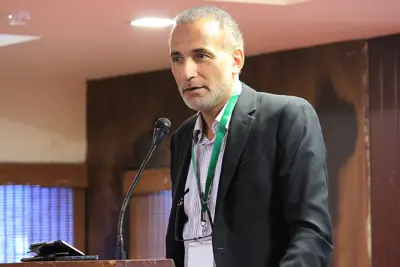
Tariq Ramadan is a Swiss Muslim academic, philosopher, and writer. He was a professor of contemporary Islamic studies at St Antony's College, Oxford and the Faculty of Theology and Religion, University of Oxford, but as of 2018 is taking an agreed leave of absence. He is a visiting professor at the Faculty of Islamic Studies at Hamad Bin Khalifa University in Qatar, and the Université Mundiapolis in Morocco. He is also a senior research fellow at Doshisha University in Japan. He is the director of the Research Centre of Islamic Legislation and Ethics (CILE), based in Doha. He is a member of the UK Foreign Office Advisory Group on Freedom of Religion or Belief. He was elected by Time magazine in 2000 as one of the seven religious innovators of the 21st century and in 2004 as one of the 100 most influential people in the world and by Foreign Policy readers (2005, 2006, 2008–2010, 2012–2015) as one of the top 100 most influential thinkers in the world and Global Thinkers. Ramadan describes himself as a "Salafi reformist".
