John Stuart Mill Quotes
What a country wants to make it richer is never consumption, but production. Where there is the latter, we may be sure that there is no want of the former. To produce, implies that the producer de_sires to consume; why else should he give himself useless labor? He may not wish to consume what he himself produces, but his motive for producing and selling is the desire to buy. Therefore, if the producers generally produce and sell more and more, they certainly also buy more and more.
Mill, John Stuart. Essays on Some Unsettled Questions of Political Economy. John W. Parker, 1844, p. 49.


In the simplistic understanding of economics at the end of the 19th century, the cause of depression was thought by many socialists and others to be over-production in times of plenty. At the beginning of the 21st century, man was still unsure of the exact causes of recession and depression, although a number of different factors were proved to be involved.


This is a classic illustration of a quotation illustrating the problem that political discussions have with the issue of causality. Conrad is absolutely correct in stating that investment and innovation as the direct cause for most productivity. However, without the demand created by consumption (or the prospect of it) there will be little capital and effort at innovation. There is a causal chain and different ideological proponents argue for their preferred link in the chain tending to ignore the other links. Many liberals tout increasing consumption and pay little attention to the investment and innovation—an error of the opposite of Conrad’s.


America’s first political economist


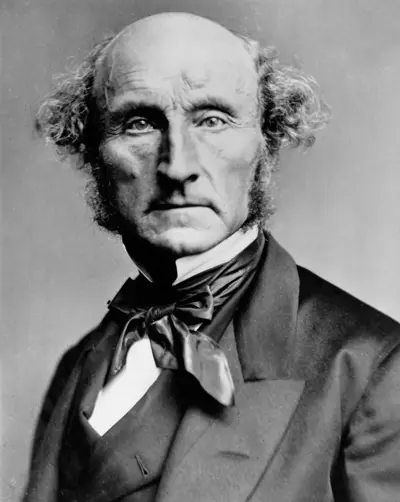
John Stuart Mill, usually cited as J. S. Mill, was an English philosopher, political economist, Member of Parliament, and civil servant. One of the most influential thinkers in the history of classical liberalism, he contributed widely to social theory, political theory, and political economy. Dubbed "the most influential English-speaking philosopher of the nineteenth century", he conceived of liberty as justifying the freedom of the individual in opposition to unlimited state and social control.
