Steve King Quotes
We've got to stand up at some point and say, 'We are not gonna pay slavery reparations in the United States Congress.' That war's been fought. That was over a century ago. That debt was paid for in blood, and it was paid for in the blood of a lot of Yankees, especially. And there's no reparations for the blood that paid for the sin of slavery.
United States, Congress, House. Congressional Record, Government Printing Office, 18 June 2009, p. H6982.


Essentially, the case of moral hazard was made against paying the slave owners. Lincoln took a pragmatic approach. However, not only was Northern opposition too strong for this proposal, but the Southern slave holders would never agree to selling their slaves. What Lincoln and most “pragmatic” Northerners did not realize is that even if the slave owners would get a fair market price for the slaves, they would be left with land and no way to work it. Their families would have no servants. They might have to work themselves like Northern farmers did, and their entire standard and style of living would be destroyed. Their sons were not well educated as many Northern young men were and were brought up to be gentlemen, politicians, and occasional soldiers—not work with their hands. They could not compete. And the slaveholders were right as the whole history of Reconstruction and backwardness demonstrated for more than 100 years.


Under questioning from Rep. Brandon Gill (R., Texas) in a House Oversight Committee hearing, March 26, 2025, Maher denied reading the referenced book or that she believed what she tweeted.


This quotation is often given by those who argue that Lincoln really did not care about the slavery issue. It is a terrific example of the limitations of quotations where there is artful rhetoric. Douglas, had in the 1st debate posed 7 “interrogatories” to Lincoln asking if he were pledged to certain positions regarding slavery. Douglas was trying to associate Lincoln with the most radical abolitionists in the land. By asking if Lincoln were pledged to the positions, Douglas thought that he had cornered Lincoln. For if Lincoln denied the pledges, he would appear to be backing off his anti slavery positions, and if Lincoln would not, then he would appear to support the most radical elements. Lincoln turned the rhetorical tables on his opponent. He first answered the question literally, emphasizing “pledged”. Just as Douglas thought he had forced Lincoln off his anti-slavery views, Lincoln stated what he would “like to see” as opposed to what he was pledged for. See {615826}.


This editorial reflected majority Southern political positions of the time. There was never going to be any compromise by ending or curtailing slavery in any way. Amongst the abolitionists, there was an equally rigid view towards compromise. Many Northerners felt that the anti-slavery Americans had been compromising for half a century and slavery was a larger institution that it ever was. They wanted no further compromise. The South had never budged from its original position at the founding of the nation. Historically, it was just a matter of time before there would be a showdown politically and probably militarily. The explosion took 10 more years.

The Baptist Churches of America were split asunder by the slavery issue. Wayland, who represented both the Northern abolitionist-leaning Baptist Churches and the Southern pro slavery churches, tried to forge a middle ground whereby slavery would end by the moral enlightenment of man and his love for fellow man as opposed to by legislation or economic pressure. He successfully predicted the outcome of the conflict except for one error he made. The conflict DID end slavery. The Baptist Church finally split into southern and northern wings in 1845. To this day, the Southern Church is extremely conservative, and fundamentalist; the Northern, very liberal and modern.


President Andrew Johnson had been impeached by the House of Representatives and was being tried in by the Senate. A majority of the Senators voted for conviction but the vote was 1 short of the two-thirds that were needed. Johnson remained in office.

The “rupture and revolution” was Southern secession and the Civil War. This quotation is very important because it so clearly states the cause of the Civil War—the threat of the abolition or change of the institution of slavery. During the late 19th century and the first half of the 20th, many historical revisionists—in an effort to promote national unity—began stating and teaching that the cause of the rebellion was a philosophical difference over State’s rights and not something so banal as the greed for and immorality of the benefits of slavery. See {621370} for another Southern quotation illustrating this point.

He stated that he had a vision and made these two prophesies that indeed came true. The first was the South Carolina secession starting the Civil War. The second, when the North used former slaves as soldiers who fought their old masters.

Note that Lincoln did not justify the emancipation proclamation on moral or humanitarian grounds, but on the grounds of military necessity.

At the beginning of the Civil War, Lincoln and many of the Union politicians hoped that the South would “come to its senses” and end the rebellion. As a result, they did not want to take all the draconian steps that they were able to. They wanted to give the Southern moderates room to maneuver and persuade the firebrands. However, there was a fundamental issue at stake—slavery—where there was no real compromise left that would have any lasting effect. The slaveholders would be destroyed in their view—possibly by the war, but certainly in the Union where the majority was strongly opposed to slavery on moral grounds.
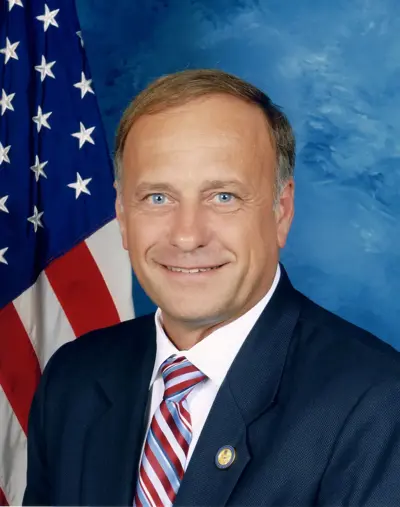
Steven Arnold King is an American politician and businessman who served as the U.S. Representative for Iowa's 4th congressional district from 2003 to 2021. A member of the Republican Party, he represented Iowa's 5th congressional district until redistricting.
