Edward R. Murrow Quotes
We must not confuse dissent with disloyalty. We must remember always that accusation is not proof and that conviction depends upon evidence and due process of law. We will not walk in fear, one of another.
Murrow, Edward R. See It Now. CBS, 9 Mar. 1954. In Search of Light: The Broadcasts of Edward R. Murrow, 1938-1961, edited by Edward Bliss Jr., Alfred A. Knopf, 1967, p. 282.


Prosecutors, even ones who are frequent lawbreakers themselves violating defendant's rights or illegally manipulating trials, are reluctant to be officially found to have done so. Many politicians start their political careers as prosecutors and then rise to higher office. If it is officially found that they had abused a defendant and violated the law, it can be detrimental to their careers. So in many states, they have placed barriers making it much harder for an improperly convicted person to even get a court hearing. The cost to society however is that they are never accountable, and people have been wrongly imprisoned and cannot even get a hearing to prove that they were the victims of official misconduct. The rationale for these rules that prevent victims from obtaining fairness and justice is finality—the concept that there should be some end to the process of appeals so justice can be said to have been done. It prevents a kind of closure for many of the victims of crimes and their families if the guilty perpetrator is constantly appealing or can do so.


This is one of the many statements of President Bush that contributed to his reputation as a polarizing politician. His supporters turned to this statement to illustrate that Bush was a supporter of the Constitution and civil liberties by urging the nation not to engage in vigilantism or give vent to their stereotypic views of minorities. Detractors took the same statement as a perfect example of Bush’s assault on Constitutional freedoms. Law enforcement does not determine guilt or innocence in our system. Police and prosecutors in America do not determine guilt or innocence; juries do. They argue that the Bush administration law enforcement policies are designed to have law enforcement usurp more and more of this facet of criminal justice.

He was subpoenaed by the House Un-American Activities Committee where he was accused of being a Communist which he eloquently denied starting with this statement. He died of a heart attack 3 days later. However, most historians agree that White passed classified information to the Russians. He was accused of being a Communist, but there was never any evidence of that. Some people believe that he was a spy for the Russians and committed espionage, but others disagree observing that White was very much his own man and felt that much information that was classified never should have been. White substituted his own judgment, it is believed, about what could be given to the Russians for the security system. He was an admirer of what Russian socialism had accomplished economically, educationally and medically since the 1917 revolution deposing the Czar. Russia had been a valuable military ally, which had taken the brunt of both military and civilian casualties in WWII. White’s economics were certainly not Marxist but very much Keynesian.

This quotation is a great example of the difficulty of deciding some of the major Constitutional issues. Most reasonable people believe that Rehnquist certainly has a point. On the other hand, critics observe that this quotation essentially says that it is OK to convict an innocent person if it cost too much or be too much trouble to do so. Reasonable people would also agree that this objection has much merit also. So the judicial system is stuck with deciding when the cost or trouble is too much. There will never, can never, be a clear cut answer.

Americans are divided as to whether this should be encouraged and helped or not.
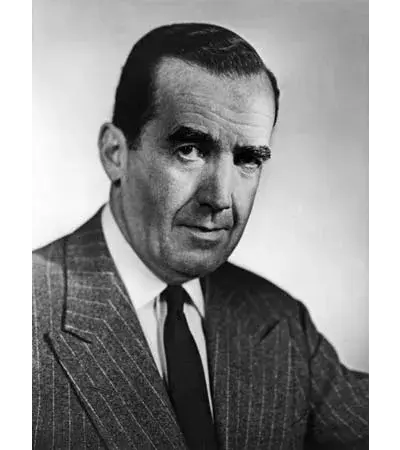
Edward Roscoe Murrow, born Egbert Roscoe Murrow, was an American broadcast journalist and war correspondent. He first gained prominence during World War II with a series of live radio broadcasts from Europe for the news division of CBS. During the war he recruited and worked closely with a team of war correspondents who came to be known as the Murrow Boys.
