Noam Chomsky Quotes
We could not bring democracy to South Vietnam at a cost that we were willing to accept. So it was a disaster. That' is the left extreme.
Chomsky, Noam, and Edward S. Herman. Manufacturing Consent: The Political Economy of the Mass Media. Pantheon Books, 1988.


sending American troops to Vietnam


President Ngo Dinh Diem of South Vietnam Diem was a creature of the Central Intelligence Agency. An anti-Communist Christian in a Buddhist county, the CIA engineered his rise to power, created his political party, provided him with cash to bribe other Vietnamese politicians, and paid for all the propaganda so he would “win” the Presidential elections. However, he abused the Buddhists, was thoroughly corrupt and ran a corrupt administration, but worst of all from the American point of view, he was unable to motivate the South Vietnamese population to fight the Communists. He reached the point where he was more of a liability, and the Central Intelligence Agency engineered a coup d’etat to remove him from power and replace him with a President more to our liking. (See {634540}.) Another reason this quotation is important is that it demonstrates the involvement that the Attorney General had with foreign and defense policy. Normally the Attorney General has nothing to do in these areas and is not even in the loop. But Robert F. Kennedy was also the President’s brother, and his advice was sought by President Kennedy on almost all matters. He was probably the most influential attorney general in American history.


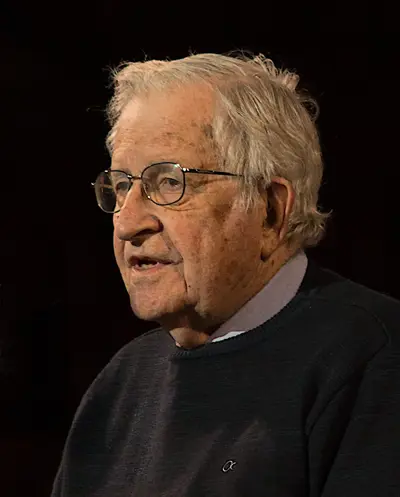
Avram Noam Chomsky is an American linguist, philosopher, cognitive scientist, historian, social critic, and political activist. Sometimes called "the father of modern linguistics", Chomsky is also a major figure in analytic philosophy and one of the founders of the field of cognitive science. He is Laureate Professor of Linguistics at the University of Arizona and Institute Professor Emeritus at the Massachusetts Institute of Technology (MIT), and is the author of more than 150 books on topics such as linguistics, war, politics, and mass media. Ideologically, he aligns with anarcho-syndicalism and libertarian socialism.
