Dwight D. Eisenhower Quotes
We can not subscribe to one law for the weak and another law for the strong; one law for us, another for our opponents.
Dwight D. Eisenhower, 1890-1969, 34th President of the United States (Republican, KS), Explanation of his opposition to the joint French-British-Israeli invasion of the Suez Canal.
Sourced by: Eigen's Political and Historical Quotations

Sealed under duress and later repudiated by the King with Papal assistance
Sealed under duress and later repudiated by the King with Papal assistance.
First Published American Indian Author. His last public speech.


If there is no rule of law, the executive, king or strongman, may handle any case in any way he wants. He can convict a poor man but let a powerful friend off. However, with the rule of law, it is the facts of the case that control, and not the identity of the law breaker. Hence the ancient Romans were somewhat suspicious of the rule of law in that it could tie the hands of the executive or magistrate and limit his discretion. To a certain extent, even modern America does not follow a completely rule of law system. The “out” is prosecutorial discretion. The prosecutors can charge one party and not bother to do so with others. An example was in 2010 when there were many bank foreclosures on home mortgages, the major banks of America were commonly committing fraud and perjury by executing legal documents allowing the forclosure, claiming that the had required documents and had done required procedure when the officers who signed the official documents had no idea what they had and just lied. The Banks had large lobbying resources, and despite the fact that felonies were committed by the tens of thousands, none of the felons was ever charged with a crime, for if they were, they were clearly guilty and there would be severe consequences. The banks promised never to do it again, and got off with none of the many guilty people ever convicted.


The Senator was arguing against a bill to correct an aspect of the immigration law where infants and very young clildren are broght to the United States by parents who entered illegally. The children grow up in the United States—the only country and home that they have ever known. American law required that they be deported to “their countries” which they have no memory of and many do not even speak the language or know the culture. Sessions, is an example of the view that law defines justice. Therefore laws cannot be unjust nor can enforcing the law. Opponents point out that even in the United States we have, in earlier times, “enforced the law” which we came to regret and see as an injustice. The Fugitive slave laws, the Southern racial discrimination laws, and the law allowing Japanese American Citizens to be interned and lose their land during WWII are a few examples of laws, the enforcement of which is seen by most Americans as having been unjust. The execution of “witches” in early America was in conformity with the law.


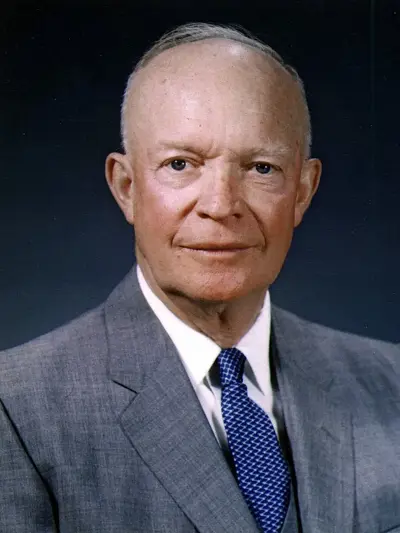
Dwight David "Ike" Eisenhower GCB OM GCS CCLH KC NPk was an American military officer and statesman who served as the 34th president of the United States from 1953 to 1961. During World War II, he became a five-star general in the Army and served as Supreme Commander of the Allied Expeditionary Force in Europe. He was responsible for planning and supervising the invasion of North Africa in Operation Torch in 1942–43 and the successful invasion of Normandy in 1944–45 from the Western Front.
