Willard Van Orman Quine Quotes
We can applaud the state lottery as a public subsidy of intelligence, for it yields public income that is calculated to lighten the tax burden of us prudent abstainers at the expense of the benighted masses of wishful thinkers.
Quine, Willard Van Orman. Quiddities: An Intermittently Philosophical Dictionary. Harvard University Press, 1987, p. 125.


For many years, the interest on home mortages have been deductible from Federal Income tax and most state income taxes. Originally, this tax subsidy was instituted to promote the idea of personal home ownership and help the real estate industry which has always had a great deal of political clout. See {634700}.


He was commercially a very successful author, and as such was in a high tax bracket.


Reacting to proposals to reduce the capital gains tax:


There are a number of periods in American history when the highest marginal income tax rate for the very wealthy was over 90 percent. The highest marginal rate is not on total income but only on the excess above a threshold amount—based on 2010 dollars, the high rate would only be paid on the income OVER $3 million in that year. Reich was right in saying that some of the greatest growth spurts of the American economy occurred at times where the marginal tax rates were over 90 percent.

This inverse relationship between rate of taxation and revenue sometimes is referred to as the Khaldun-Laffer Curve or the Laffer Curve. However, Khaldun appears to by the first to document the relationship, David Hume, Keynes, and others have since. This quotation’s exact source is unknown and may possibly be a bogus quotation as it reflects a classic view of one of the partisan political philosophies. However, there are several references and for now we lean toward accepting it as authentic. Khaldun was one of the world’s greatest polymaths who among his other accomplishments was the “Father of Sociology” and was the leading Islamic intellectual of his era.


The nation rejected the flat tax that was favored by conservatives in the 1930s. However, in the Republican Presidential Primary Campaign of 2000, candidate Steve Forbes made the flat tax a centerpoint of his campaign. He lost badly, but the idea caught on amongst some conservative Republicans, and has had some support since.


This was a typical argument in the 2012 battle between President Obama and the Republican conservatives. However, this was written 35 years earlier, when the exact same issue was polarizing politicians. The idea for taxing the rich more to reduce the deficit has been around since there was a Federal deficit. On most occasions the rich had enough political clout to avoid additional taxes for them and get the general public to pay instead of them. However, there have been times where they have not been able to avoid increased taxes. The New Deal lead by Franklin Delano Roosevelt and the Obama administration in 2013 were two such exceptions.
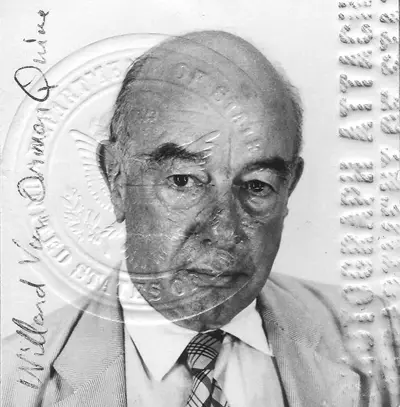
Willard Van Orman Quine was an American philosopher and logician in the analytic tradition, recognized as "one of the most influential philosophers of the twentieth century." From 1930 until his death 70 years later, Quine was continually affiliated with Harvard University in one way or another, first as a student, then as a professor. He filled the Edgar Pierce Chair of Philosophy at Harvard from 1956 to 1978.
