Jacob Duche Quotes
We beseech thee, upon these our American states who have fled to thee from the rod of the oppressor and thrown themselves upon thy gracious protection, desiring henceforth to be dependent only on thee. To thee they have appealed for the righteousness of their Cause; to Thee do they look up, for that countenance & support which Thou alone canst give. Take them, therefore, Heavenly Father, under thy nurturing care: give them wisdom in council, valour in the field. Defeat the malicious designs of our cruel adversaries. Convince them of the unrighteousness of their cause. And if they persist in their sanguinary purposes, O! let the voice of thy unerring justice sounding in their hearts constrain them to drop the weapons of war from their enerved hands in the day of battle. Be thou present, O God of Wisdom and direct the counsels of this honorable Assembly. Enable them to settle things upon the best and surest foundation, that the scene of blood may be speedily closed; that harmony and peace may effectually be restored, and truth and justice, religion and piety prevail and flourish amongst thy people. Preserve the health of their bodies and the vigor of their minds; shower down upon them and the millions they represent such temporal blessings as Thou seest expedient for them in this world, and crown them with everlasting glory in the world to come. All this we ask in the name and through the merits of Jesus Christ thy son, Our Saviour, Amen.
This quotation is the first prayer of the first Congress. Some advocates of a more religious role in government use this quotation to illustrate that not only was religion a part of the first Congressional deliberations, but it was a Christian prayer. Of course, the Constitution would not be created for another 13 years and there was no provision for separation for church and state in the Continental Congress—there was not even an executive. Duche was later captured by the British and was persuaded to write a letter to George Washington {583740} asking that he lay down his arms. John Adams described him to Abagail: “Mr. Duche I am sorry to inform you has turned out an Apostate and a Traytor. Poor Man! I pitty his Weakness, and detest his Wickedness.”
Jacob Duche, 1737-1798, Protestant Minister & Rector of Christ Church in Philadelphia, Pennsylvania, Chaplain to the First Continental Congress, Prayer opening the first Continental Congress of the United States, September 7, 1774
Sourced by: Eigen's Political and Historical Quotations

Duche had given the first prayer in the First Continental Congress {583741} and was an early patriot. However, he was captured by the British and pressured to write to Washington asking him to stop the fighting. John Adams wrote to his wife: “Mr. Duche I am sorry to inform you has turned out an Apostate and a Traytor. Poor Man! I pitty his Weakness, and detest his Wickedness.”

This proposal and others like it over the years have never even gotten out of Committee.


The Pilgrims at Plymouth celebrated the first American Thanksgiving in 1621. George Washington had declared November 26, 1789 a day of thanksgiving. During the raging Civil War, President Lincoln had fixed the last Thursday of November to be a “Day of Thanksgiving”. Geary was following precedent and helping to make a tradition. However, there were those at the time who objected to the last sentence of the quotation as being overly sectarian and violating the separation of church and state doctrine. See

See {611241}, {611246}, {611442}. While the issues with Cromwell were essentially political, there were substantial theological and cultural issues between the Quakers and other protestant sects which even extended across to the New World. See {612011}

In 1872 a proposed Constitutional amendment was debated throughout much of the country. The proposed “Christian Amendment” to the Constitution, recognized the Bible, God, and made Christianity the state religion requiring religious tests of public officials including belonging to an organized Christian Church. “Deists” as used then referred to people who had a general belief in a Supreme Being but did not belong to any formal or organized church.

Judge Moore was trying to justify oaths to God or other state references to a Judeo-Christian God as not violating the 1st Amendment stricture about the government endorsing a particular religion. Note however his {33827} quotation.


Barton and some other Christian Fundamentalists did not believe that a prayer should be offered by a religion that was not monotheistic. Some actually disrupted the Senate prayer in protest. See {583752}.

Protesters in the Senate gallery were outraged that a Hindu would be allowed to lead a prayer opening the Senate. They disrupted the proceedings and were arrested. See {583752}.


This oath was even in force after the American Constitution was ratified and in effect. At the time, the Bill of Rights was not believed to be binding on the States—only on the Federal Government. Throughout American history there were many practices that were unconstitutional but were simply never litigated in the courts. Local community pressure often inhibited individuals from asserting their rights in the Federal Courts as did the expense. So, for most of American history local communities forced stores to close on Sunday. When the issue was finally taken to the Supreme Court, it was clear that such a practice was in violation of the First Amendment. Even in 2011, in Atlanta, it is “illegal” to buy beer on Sunday. When someone decides to litigate that, it will likely also be declared unconstitutional. The law not only discriminates against non Christians, but there are a few Christian sects which believe that Saturday is the Sabbath.

The wording was rejected and the delegates insisted upon the original proposed language: “Well aware that Almighty God hath created the mind free …” This is a very important historical quotation because it shows that Henry and a few others wanted to make the society Christian centric, However, the majority insisted that it be non-sectarian. Many of the delegates rejecting the “Jesus Christ” language were themselves practicing Christians, but they were aware of the terrible religious wars and strife in Europe and between Christians and Muslims as well as the persecution of Jews, Quakers, and other sects; they did not want that in America so they rejected the idea of an established Christian Church or culture.

During the American Revolution, conditions were very difficult for Washington’s soldiers who were ill armed, ill clothed, and ill fed while they were paid irregularly. At one point morale was so low that some of the soldiers revolted. Smyth observes that Washington and Congress disciplined the mutineers very mildly, especially when compared with the way the British would deal with such things. The British Governor Clinton tried to take advantage of the mutiny and the poor morale by announcing that all of Washington’s troops who wished could obtain amnesty and join the British forces where the pay and conditions were much better. Professor Smyth found it fascinating that none of the Americans would join the British and he credits it to the wise and mild discipline policies of Washington and Congress as well as the general perception of the justice of the American cause among the American troops.


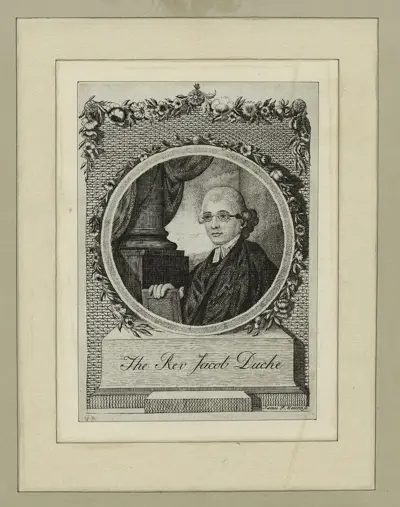
The Reverend Jacob Duché (1737–1798) was a Rector of Christ Church in Philadelphia, Pennsylvania, and the first chaplain to the Continental Congress.
