John Paul Jones Quotes
Was it proof of madness in the first corps of sea officers to have, at so critical a period, launched out on the ocean with only two armed merchant ships, two armed brigantines, and one armed sloop, to make war against such a power as Great Britain?
Jones, John Paul. Memorial to Congress. 1787. Life and Correspondence of John Paul Jones, edited by Robert Charles Sands, D. Fanshaw, 1830, p. 43.


Military men tend to rely so much on military history that they are almost always fighting the last war. Soon air power would supplant sea power as the critical factor. Then nuclear power, and then nuclear weapons became too severe for actual use and yet wars still continued with no consensus as to that will be in the future.

Koxinga had an overwhelmingly superior force, and wanted the Dutch to surrender and avoid bloodshed. The Dutch with their typical European colonial attitude, had great difficulty surrendering to “natives” even if outnumbered. Finally, the Dutch Commander agreed to surrender. Koxinga then established a Chinese Government on the Island and became a great hero of the Ming Dynasty. Note the graphic of the statue to him which is one of the very few Chinese memorial statues to a military hero showing him in action—very similar to European statues. Already Koxinga’s massed wooden junks with small cannon and fire torches had sunk one of the Dutch warships (they were not iron but had some iron plates on the deck to protect the gunners) and there were so many junks that the other Dutch ships sailed out to sea to avoid the Chinese huge number of junks.


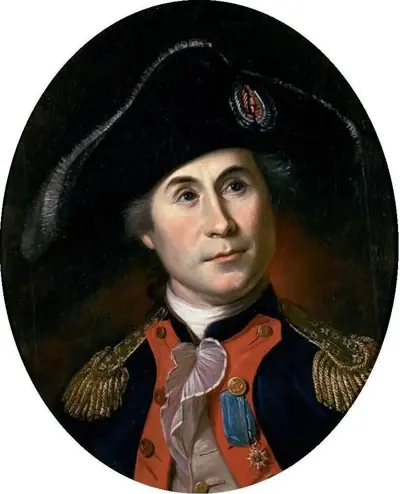
John Paul Jones was the United States' first well-known naval commander in the American Revolutionary War. He made many friends among U.S political elites (including John Hancock and Benjamin Franklin), as well as enemies (who accused him of piracy), and his actions in British waters during the Revolution earned him an international reputation which persists to this day. As such, he is sometimes referred to as the "Father of the American Navy" (a sobriquet he shares with John Barry and John Adams).
