Archibald Cox Quotes
Unlike a monarch, the President is not the Sovereign.
Archibald Cox, Watergate Special Prosecutor, Legal memorandum, Aug, 13, 1973
Sourced by: Eigen's Political and Historical Quotations

This letter was written shortly after the Constitution had been signed by the convention delegates. This difference between Adams and Jefferson would be at the heart of the first great partisan struggle in American history. Adams, as the second President, tried to increase and use the power of the Presidency. Jefferson opposed him, especially when Adams tried to run for a second term. The Adams-led Federalists were pitted against Jefferson’s Democratic Republicans in the first, and perhaps still the most bitter partisan struggle in American political history. The Jeffersonians accused Adams and the Federalists of trying to unravel the American Revolution and revert to a monarchy. The people not only sided with the Democratic Republicans, ousting Adams, but also turned out most of the Federalists. It was the end of the Federalist Party, and a new conservative party—without monarchial tendencies—the Whigs became the new opposition party.

1st Earl of Beaconsfield

Randolph was one of the delegates who opposed a Presidency of a single man.


Although a right wing conservative, he shared the view of many liberals that it costs so much money and needs so many rich contacts to raise enough money to run for President, that the reality is beyond the reach of ordinary Americans. Since Harry Truman, all the Presidents have been affluent, and most millionaires.


From this quotation, {624648} and {615902} it is clear that the framers of the Constitution intended the treaty making powers to be shared by the President and the Senate. In practice, in modern times treaties are usually initially negotiated by diplomats under the supervision of the President and the Senate gets to concur or not in the ratification process. However, there have been a number of treaty failures including the League of Nations where the lack of coordination has resulted in a situation where the Senate had to accept or reject something which the President had negotiated and the Senate rejected the treaty.

When the Senate was debating the Gulf of Tonkin Resolution, which would empower the President to take "all necessary measures" to repel any armed attack on U. S. forces, Senator Morse was one of only two Senators opposing the resolution:

See {592811} for Adams response.

The naval hero was approached as to his reception to a presidential draft. His famous response eliminated most interest in him. If Congress selected the President, he may well have won.

Attacking FDR by pandering to anti-Semites and falsely claiming that a Jewish financier, Bernard Baruch ran the government: The Priest was the right wing demagogic radio host of his day. Virulently anti-Semitic and anti-Black, he was threatened with excommunication by the Catholic Church, which finally ordered him to cease us weekly radio show and stop the political hate.

Anthony Ashley Cooper
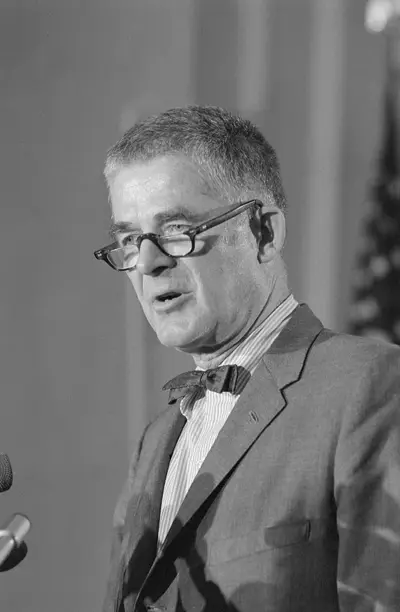
Archibald Cox Jr. was an American lawyer and law professor who served as U.S. Solicitor General under President John F. Kennedy and as a special prosecutor during the Watergate scandal. During his career, he was a pioneering expert on labor law and was also an authority on constitutional law. The Journal of Legal Studies has identified Cox as one of the most cited legal scholars of the 20th century.
