Jimmy Carter Quotes
Two problems of our country - energy and malaise.


Nixon was the last Republican President in the 20th century to favor public transportation and mass transit. By the beginning of the 21st century, there were almost no Republican member of Congress would was interested in public transportation and most opposed all efforts at such.

At the time, millions of Americans had no access to electrical power, especially in the rural areas. FDR and the New Deal changed that for millions of Americans with the Rural Electrification initiatives. Private electric utility corporations wanted the monopoly but did not want to sever everyone. The cost to electrify a densely populated area is much less on a per capita bases than for a rural area where it might take 25 miles of wire to serve 5 families as opposed to a city where the same 25 miles of wire might serve 5000 or even more families. The only solution of for the densely populated area to pay a little more and subsidize the rural areas home and farm electricity and require the utility corporations to serve everyone. That is essentially what happens today, and the subsidy not only comes from higher rates but also the general tax revenue of the Federal Government and many states. Before the New Deal, under Hoover there was no federal attempt to solve this problem. FDR’s administration, however come up with a number of ways, many of which are still in use today.


The American public did not accept the need for conservation during Carter’s administration. Carter and many people then thought the major problem was that we were running out of fossil fuels. With shale gas and other techniques there was much more fuel that was suspected. However, the real problem was clean fuel and carbon causing global warming. So wind, solar and other “clean” energy sources have become very inporantant.

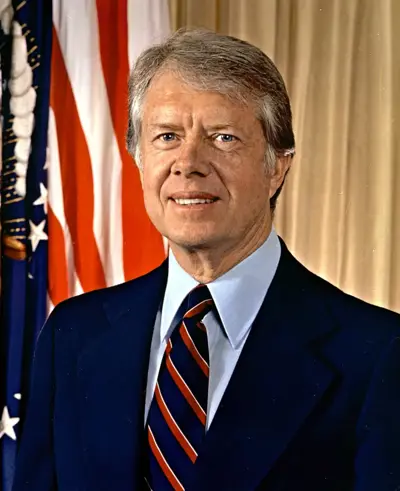
James Earl Carter Jr. is an American politician, businessman, and philanthropist who served as the 39th president of the United States from 1977 to 1981. A member of the Democratic Party, he previously served as a Georgia State Senator from 1963 to 1967 and as the 76th governor of Georgia from 1971 to 1975. Since leaving the presidency, Carter has remained engaged in political and social projects as a private citizen. In 2002, he was awarded the Nobel Peace Prize for his work in co-founding the Carter Center.
