Richard P. Feynman Quotes
…trees are made of air, primarily. When they are burned, they go back to air, and in the flaming heat is released the flaming heat of the Sun which was bound in to convert the air into tree. And in the ash is the small remnant of the part which did not come from air, that came from the solid earth, instead.
Richard P. Feynman. Quoted in Tegmark, Max (2014-01-07). Our Mathematical Universe: My Quest for the Ultimate Nature of Reality (Kindle Locations 138-139). Knopf Doubleday Publishing Group. Kindle Edition.
Sourced by: Eigen's Political and Historical Quotations


This very famous quotation says that the total amount of energy in a system always remains the same. It may, change from one form to another like heat to light, but it is always there in one form or another.

This quotation illustrates how scientifically sophisticated some of the Founding Fathers were.

This is a very interesting philosophical and scientific quotation because he states that in Science, matter and energy are equivalent, which 40 years later would be asserted and proven by Albert Einstein in his Theory of Relativity. There were no notes or details ever found from Ludlow, and he certainly did not have the mathematical background to have showed or proved the mathematical relationship. It was almost certainly a type of metaphysical statement and surely he had no idea of how accurate it was.

The Congress had voted to require 10 percent of all the gasoline sold in America to be alcohol made from corn to reduce the air pollution of car driving. They precluded using Brazilian alcohol made from sugar cane which was already available and far less expensive. In a classic example of unintended consequences the price of grain worldwide increased harming some of the very poor nations. The price of corn run increased in the United States because the law required corn alcohol and nothing else was allowed. Farmers across America switched from wheat, soybeans and other grains to corn to earn more money. This then diminished the American supply and raised the price of wheat and other grains which Americans could afford but much of the rest of the world could not. And now the U. S. had less grain to export driving the world price higher. Worst of all, the environmental impact was negative—not positive. In addition to the carbon dioxide problem Daschle discusses in this quote, the electrical energy that was generated with oil and needed to turn the corn into alcohol required more oil than was saved by using the alcohol. Everyone lost except the corn farmers. The political promises to make corn alcohol required were made by most of the candidates during the Iowa presidential primaries the previous year.


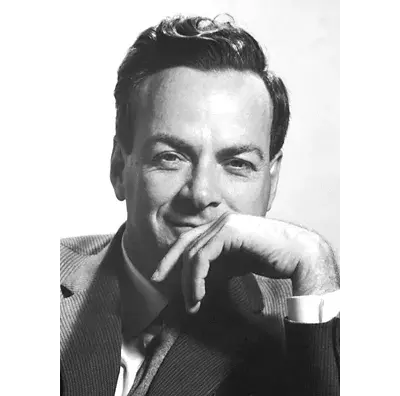
Richard Phillips Feynman was an American theoretical physicist and Nobel Prize winner who made significant contributions to quantum mechanics, quantum electrodynamics, and particle physics. He's known for his work on the Manhattan Project, developing Feynman diagrams, and explaining the interactions between light and matter. While studying for his PhD, Feynman participated in the Manhattan Project and helped develop the atomic bomb. For contributions to the development of quantum electrodynamics, Feynman received the Nobel Prize in Physics in 1965 jointly with Julian Schwinger and Shin'ichirō Tomonaga.
