Joseph Stalin Quotes
Toys to frighten children
Stalin used this phrase during the period when the U. S. had nuclear weapons and the Soviet Union did not. Stalin had his scientists working frantically to catch up but in the interim he outwardly displayed a bravado diminishing the military importance of nuclear weapons and minimizing the disadvantage that the Russians were at.
Joseph Stalin, 1879-1953, Russian Premier, Description of Atomic Bombs, quoted by Historian Niall Ferguson, Lecture & Podcast, London School of Economics, 2010
Sourced by: Eigen's Political and Historical Quotations


3 days later, President Truman, announced that the Russians had successfully developed an atomic weapon. This quotation gives us another example where the Central Intelligence Agency failed to predict and/or warn America about a crucial event. Others included the North Korean invasion of South Korea, the Arab Spring, the Soviet invasion of Afghanistan, the fall of the Berlin wall, and the collapse of the Soviet Union.

This prediction was sadly terribly accurate. Nuclear terrorism is a realistic threat at the millennium. Pannekoek was one of the first to predict it.


This statement told the world that the United States might preemptively attack Iraq because the Iraqis were developing nuclear weapons. Bush ordered the invasion of Iraq and there it turned out that was no nuclear program of any type in Iraq. There has been a debate ever since as to whether Bush and his key advisors lied knowingly to justify a war they wanted, wanted the war and pressured the intelligence agencies to warn of a clear nuclear development program, or were duped by incompetent intelligence agencies. While American troops were bogged down in Iraq, North Korea tested a nuclear weapon and Iran announced an enrichment program for weapons grade.

This rhetoric turned out to be just that. When Israel developed a nuclear capability, the Egyptians became more rational and sobered. It was Anwar Sedate however who was the Egyptian leader wise enough and strong enough to make peace with Israel.

Canada had the same absurd civil defense propaganda in the Cold War as the U. S. did. Both governments wanted to persuade their publics that a nuclear attack was survivable.

Israel started it nuclear weapons program under Perez’s leadership. They do not admit that it is even in existence. Yet all their potential enemies in the Middle East realize that they have enough nuclear weapons capacity that if they are in danger of being overrun, they can literally destroy the attacking nation and all the countries that might be assisting that nation. Before Israel had developed this capability, some in the Middle East had as their objective to destroy the state of Israel and “drive the Jews into the sea”. No one believes that it is now possible to militarily defeat Israel without the attacking nations also being destroyed. For years, Israel has had the military might to conquer any nation in the Middle East and use their nuclear shield to protect them from any interference, but they have not done so demonstrating that the Israeli governments will not use nuclear weapons for any other purpose.


One new danger that nuclear powers add to the usual problems of conflict, is that a nuclear power, about to lose a war in a humiliating way, might just use his nuclear weapons in revenge. So much damage will be done that the victory turned out to have been a bad thing. So ironically, with a nuclear enemy. Your military dare not win to dominantly with conventional weapons.


The alternative deterrent was to maintain an army of over 2 million men overseas in both Europe and Asia, and the cost was much greater than the then perceived cost of nuclear weapons. At the time no one figured the cost of coping with the radioactive material and waste as well as the cleanup of nuclear bomb factories like Hanford. These costs were still not known byt the 21st century.

The Scientific Project that developed the Atomic Bomb. The Scientific Project that developed the Atomic Bomb
The Scientific Project that developed the Atomic Bomb. The focus of the scientists had been to beat the German’s who were terribly evil might develop a bomb first. After the defeat of some scientists began to have concerns about their purpose. Most were very distrustful of the army and believed little of what they were told, by the military at Los Alamos. However, in a remarkable our de force of leadership, Oppenheimer had the trust of virtually all of the staff. This memo and a briefing of the invasion plans of mainland Japan (see {629858} ) convinced the scientist to maintain their intense and punishing pace.
The Scientific Project that developed the Atomic Bomb

Fermi was the scientist who organized and planned the first controlled nuclear chain reaction as a part of the Manhattan Project and was one of the major scientific advisors to the Atomic Energy Commission until he, Oppenheimer, and several other scientists opposed the development of the Super (the name Edward Teller had given to the proposed hydrogen bomb). The scientists knew that we had and could make enough atomic bombs to destroy any nation and to make it doable with just a few bombs as opposed to many they saw as of little military
value. They further expected that the Russians and some others would be forced to keep up with us in an arms race and that the bomb would never be able to be used without retaliation in kind and the destruction of most of America. The politicians and military did not really believe that the Russians had the scientific capability to develop hydrogen weapons and some thought if we had them and no one else did, we could dictate a “pax Americana” to the world. Others feared that Russia or some other country would develop a hydrogen weapon and then dictate to us. We did have a monopoly on the Super for a few years and America never dictated to the rest of the world. When other countries developed the weapons, we entered the era of Mutually Assured Destruction (MAD).


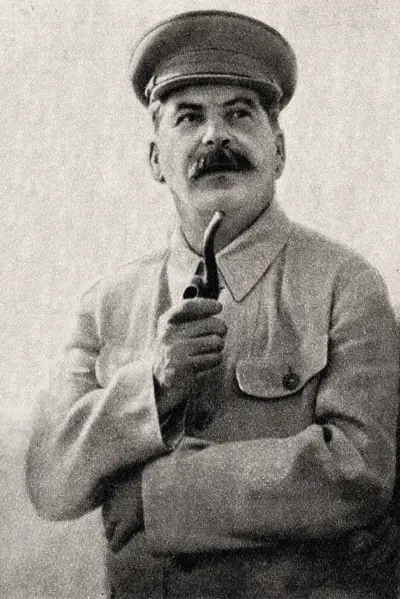
Joseph Vissarionovich Stalin was a Georgian revolutionary and the ruler of the Soviet Union from 1927 until 1953. He served as both General Secretary of the Communist Party of the Soviet Union (1922–1952) and Chairman of the Council of Ministers of the Soviet Union (1941–1953). Despite initially governing the country as part of a collective leadership, he ultimately consolidated power to become the Soviet Union's de facto dictator by the 1930s. A communist ideologically committed to the Leninist interpretation of Marxism, Stalin formalized these ideas as Marxism–Leninism while his own policies are known as Stalinism.
