Albert Einstein Quotes
Today the atomic bomb has altered profoundly the nature of the world as we know it, and the human race consequently finds itself in a new habitat to which it must adapt its thinking... Never before was it possible for one nation to make war on another without sending armies across borders. Now with rockets and atomic bombs no center of population on the earth's surface is secure from surprise destruction in a single attack.... We cannot leave it to generals, senators, and diplomats to work out a solution over a period of generations… There is no defense in science against the weapon which can destroy civilization. Our defense is not in armaments, nor in science, nor in going underground. Our defense is in law and order… Future thinking must prevent wars.
Albert Einstein, 1879-1955, Nobel laureate in Physics, 1946
Sourced by: Eigen's Political and Historical Quotations


3rd Earl Russell of Kingston. The military weak nations agreed with him, but the militarily strong ones did not—especially America and England which had the Atomic Bomb when others did not.


This is a variant of the famous linkage of liberty with eternal viligance. See {626344} and {235421}.


Having just been told of the Hiroshima atomic bombing:


This quotation illustrates Jefferson’s isolationist streak. He would have abandoned all American oceangoing ships and thereby avoid war. When he became President, however, he rethought his earlier position and was aggressive in developing the American Navy, using it at the risk of war.


The documentation of this quotation comes from a memorandum summarizing the meeting written by Presidential aide Harry Hopkins.

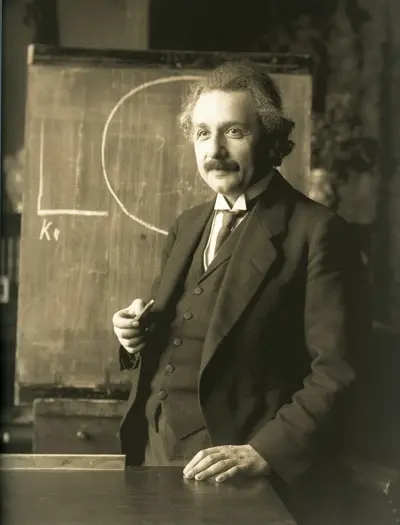
Albert Einstein was a German-born theoretical physicist, widely acknowledged to be one of the greatest physicists of all time. Einstein is known for developing the theory of relativity, but he also made important contributions to the development of the theory of quantum mechanics. Relativity and quantum mechanics are together the two pillars of modern physics. His mass–energy equivalence formula E = mc2, which arises from relativity theory, has been dubbed "the world's most famous equation". His work is also known for its influence on the philosophy of science. He received the 1921 Nobel Prize in Physics "for his services to theoretical physics, and especially for his discovery of the law of the photoelectric effect", a pivotal step in the development of quantum theory. His intellectual achievements and originality resulted in "Einstein" becoming synonymous with "genius".
