Paul Singer Quotes
Today, even small entities that trade complex instruments or are granted sufficient leverage can threaten the global financial system.
Singer, Paul. "A Free-Market Alternative to Dodd-Frank." Manhattan Institute, 2012.

Despite this warning, and the hundreds of billions of dollars of people’s money that was lost on derivatives, and recommendations for not allowing derivatives to bought or sold by institutions who invest the public’s money, derivatives were not outlawed by Congress in its efforts to reregulate the financial industry.

U. S. Treasury Secretary Larry Summers called Rajan a “Luddite” for this view, but what Rajan observed and predicted was exactly what happened in the Meltdown of 2008 which led to the Great Recession. Rajan was one of the few economists to call this right. Several, invested their own money assuming a crash and made billions. Most, like Summers and the Federal Reserve Chairmen in retrospect admitted that they missed the signs and didn’t connect the dots. See {637168}, {637987}, and {620038}

She had warned about the unregulated derivatives 10 years earlier, but to no avail. See {637987}. Then when she had been proven prescient in the Meltdown of 2008, Congress was more interested in how she thought they could prevent future problems with derivatives. Some were adopted but not all. The financial institutions claimed that they needed derivatives to hedge positions and hence “stabilize” the system. Of the members of Congress who voted on this issue, almost none understood derivatives and credit default swaps were and how they worked. But some were sure they were bad, and others were sure that they were necessary for stability. Derivatives can, and did, get so complicated that the people who originally created them sometimes cannot tell whether they are at risk or not. Even computer cannot calculate the value and risks of these instruments because the values and risks depend on what happens to other companies or instruments which themselves have derivatives insuring them. See {620038} for a good description of the difficulty.


Credit default swaps were in large part responsible for the melt down of the economy of 2008 and the Great Recession thereafter. A credit default swap was one of the favorite derivatives that became popular. Is an insurance policy that a company will pay off its bonds and not go bankrupt. It is a cross between an insurance mechanism and a stock exchange type security mechanism, and through heavy lobbying, escaped any kind of regulation. It cost a company no money to write a credit default swap, and they were paid to do so. As long as business and the economy was good, it was a terrific business but there was no way of ever knowing how much risk they were taking. So companies who wrote credit default swaps did not have to have the money to pay to back them up. When that happened in 2008, even the largest insurance company in the world collapsed because of the risk of having to pay the credit default swap and the U. S. Government had to take over the insurance company. In 2010, the Obama administration passed a financial reform bill that began to regulate credit default swaps. Buffet, the American who had made the most money in financial securities, realized the great danger not only to the company, but to the entire national economy. Most of the rest of the financial institutions, could make large amounts of money without have to have much capital as long as things went well. So credit default swaps began to exceed the other financial instruments in activity. Neither the Federal Reserve or the other government regulatory agencies chose to regulate these risky instruments nor even to require that they be publicly disclosed -- See {637987}, {637986} and {637992}.

When the Meltdown hit America, the crisis drew attention to the fiscal solvency and stability of banks in most of the world. The Irish banks were much more overextended than those of most counties and when that came to light there was a bank panic in Ireland. Ahern and the Irish Dail (parliament) decided to bail out the Irish bank at a very great cost to the rest of the Irish economy and people. He believed if Lehman Brothers had been bailed out, as America did with other institutions, the Irish bank bubble would not have burst. It is not known whether he actually meant to use the word “testicles” or he made a gaff intending to use the word “tentacles”. Both have relevant meaning in the situation with a significant shade of difference in meaning between the two.
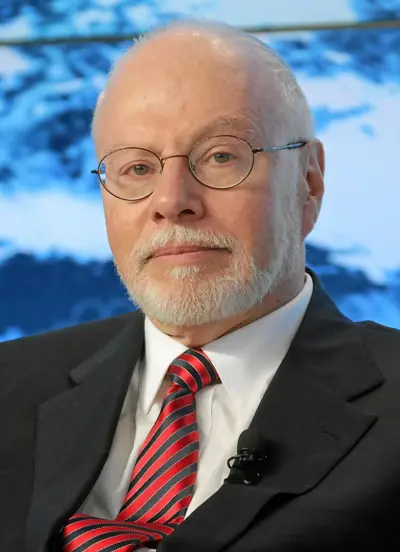
Paul Elliott Singer is an American hedge fund manager, activist investor, philanthropist, and the founder, president and Co-CEO of Elliott Management.
