Ralph Bunche Quotes
To suggest that war can prevent war is a base play on words and a despicable form of warmongering. The objective of any who sincerely believe in peace clearly must be to exhaust every honorable recourse in the effort to save the peace. The world has had ample evidence that war begets only conditions that beget further war.
Bunche, Ralph. "Some Reflections on Peace in Our Time." Nobel Lectures, Peace 1926-1950, edited by Frederick W. Haberman, Elsevier Publishing Company, 1972.


In the play the two characters are a Russian and American disarmament negotiator:


Theodore Roosevelt was the Presidential nominee. Johnson was a leader of some members of Congress some of whom were extreme isolationists and some of whom were Nazi sympathizers and Hitler admirers. When the Japanese attacked Pearl Harbor later that year, Germany, fulfilling its treaty with Japan, declared war on America, Johnson’s group no longer mattered. Before WWII most Republicans were opposed to Defense Spending and accused the Democrats of being war hawks. After WWII, they flip flopped and became more hawkish than the Democrats who they accused of being soft on defense for years thereafter. See {631380} for President Roosevelt’s different view.

Shortly after, he backed off the notion of having a bloodbath removing protesting students.

This was Ford in the middle of his career. As he got older, he changed radically. He was later one of the biggest supporters and admirers of Adolf Hitler and his aggressive militarism.

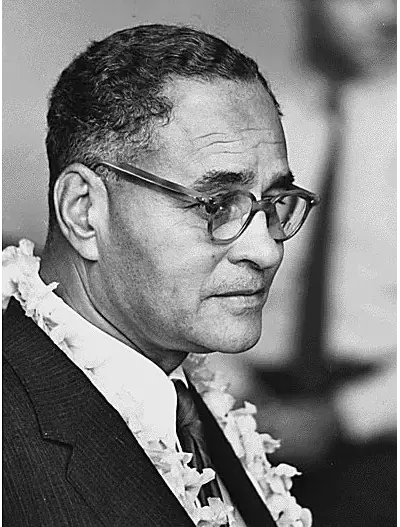
Ralph Johnson Bunche was an American political scientist, diplomat, and leading actor in the mid-20th Century decolonization process and US civil rights movement, who received the 1950 Nobel Peace Prize for his late 1940s mediation in Israel. In the List of black Nobel laureates he is the first African American and first person of African descent to be awarded a Nobel Prize. He was involved in the formation and administration of the United Nations and played a major role in both the decolonization process and numerous peacekeeping operations sponsored by the UN. In 1963, he was awarded the Presidential Medal of Freedom by President John F. Kennedy. At the UN, Bunche gained such fame that Ebony magazine proclaimed him perhaps the most influential African American of the first half of the 20th Century and "[f]or nearly a decade, he was the most celebrated African American of his time both [in the US] and abroad."
