Paul Krugman Quotes
To have to claim that … workers were impoverished by globalization … you have to forget that those workers were even poorer before the new exporting jobs became available and ignore the fact that those who do not have access to the global markets are far worse than those who do.
Paul Krugman, Economist & Political Columnist, Nobel Laureate in Economics, Column, Slate, November 23, 1999
Sourced by: Eigen's Political and Historical Quotations

the Bolshevik Communists of Russia Zenzinov was often a critic of the Bolsheviks.


Discussing NAFTA and free trade with Mexico where the minimum wage was only 69 cents:


Hoover, a brilliant administrator, seems to have been on the wrong side of most economic issues.

Ten cents a day was a very low wage—it was about the equivalent of a meal at a tavern at the time. Workers throughout the country were outraged and give him a derogatory nickname—see Quotation 643585.


Although aggregate employment has remained relatively stable as global free trade has become the U. S. policy, there has been major employment disruption with some types of people benefiting and others like blue collar manufacturing workers having their entire careers wiped out. Port cities like Seattle, Baltimore have boomed while Midwestern manufacturing cities have deteriorated greatly.


Foreign trade creates jobs and eliminates jobs. The people who lost jobs as the result of increased foreign trade are readily identified while the job beneficiaries may never know the reason. So it is a hard political sell even though most of the economic studies have showed that more jobs of more value are created by trade than lost. However, the losers are generally blue collar workers while the beneficiaries are generally white collar and knowledge workers. So there is a socioeconomic class differentiation in the trade issue.

Despite this economic reality, many underdeveloped nations sell their raw materials because it is easier than the alternative which takes capital investment in processing plants and equipment, training of workers, and establishing a marketing mechanism. Most third world nations are limited in their capacity to do this but they have abundant natural resources.

She was writing about the textile mills of Manchester, England in the Industrial Revolution. Workers’ wages were so low that many of them could not feed themselves and their family decently

It has been the blue collar worker who has borne the economic brunt of globalization in the industrial democracies. It was their jobs who moved off shore, their wages that were under pressure from low wage workers in emerging nations.


Bonior and many others believe that NAFTA was the cause of the worker displacement. Others believe that the forces causing loss of well-paying manufacturing jobs—robotic replacement of human workers and offshoring—were already in existence and were reaching their high rates at shortly after NAFTA. Correlation in time does not necessarily imply causation.

Jefferson was one of the first political and economic thinkers to express concern over the “wage slave” concept of the industrial revolution. This was one of the major reasons that he was not in consonance with Alexander Hamilton in his economic vision for America. While we followed the Hamilton direction, there are still issues of maintaining freedom and independence for an employee in modern nations and economies.
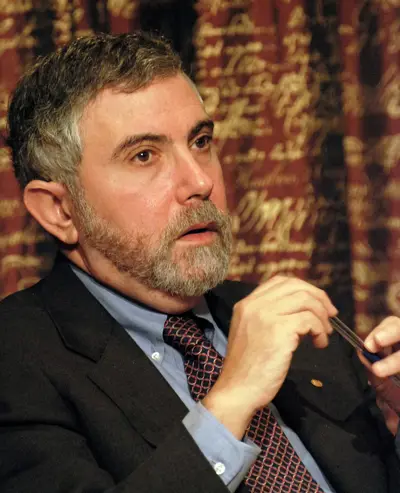
Paul Robin Krugman is an American economist who is the Distinguished Professor of Economics at the Graduate Center of the City University of New York, and a columnist for The New York Times. In 2008, Krugman was awarded the Nobel Memorial Prize in Economic Sciences for his contributions to New Trade Theory and New Economic Geography. The Prize Committee cited Krugman's work explaining the patterns of international trade and the geographic distribution of economic activity, by examining the effects of economies of scale and of consumer preferences for diverse goods and services.
