George Washington Quotes
To an active external commerce the protection of a naval force is indispensable ... it is in our own experience that the most sincere neutrality is not a sufficient guard against the depredations of nations at war. To secure respect to a neutral flag requires a naval force organized and ready to vindicate it from insult or aggression. This may even prevent the necessity of going to war by discouraging belligerent powers from committing such violations of the rights of the neutral party as may, first or last, leave no other option…. These considerations invite the United States to look to the means, and to set about the gradual creation of a navy.
The United States had no navy at that point.
George Washington, 1732-1799, 1st President of the United States (VA), Eighth Annual Message to Congress, December 7, 1796
Sourced by: Eigen's Political and Historical Quotations


Most Americans do not realize that our naval forces were disbanded after the Revolution and even the Constitution did not require a navy. We had some Federal revenue cutters to interdict smugglers but no warships and no permanent sailors or officers. The Barbary Pirates had an incredible extortion racket going in the Mediterranean. If nations would pay them an annual sum each year, they would not attack and seize merchant ships of that country and sell the ships and goods while holding the sailors for ransom. See {640850},86703,{640846} & {640848}
He was referring to attacking the Barbary States. The Barbary Pirates had an incredible extortion racket going in the Mediterranean. If nations would pay them an annual sum each year, they would not attack and seize merchant ships of that country and sell the ships and goods while holding the sailors for ransom. See {640846}.

This quotation illustrates some of the interesting attitudes of early Americans. First, note the backhanded slap at a standing army. The navy was much preferred by early Americans as history had demonstrated that most republics had been destroyed by their own armies taking over in some “emergency” of time of “crisis.” This also helps explain why the army and navy were different departments of government—a tradition that lasted until after WWII. The two departments had totally different purposes and objectives and presented different potential dangers to the nation.


Raiders operating out of the Barbary Coast typically would attack any American shipping seizing the goods and the ship and ransoming the crew or passengers or selling them as slaves. English and French governments had paid the Tripoli tribute for safe passage. The President and Congress sent American ships to in effect blockade the corsairs in their harbors.


The notion of America flexing its military muscles and intimidating other nations by sending a fleet of 16 battle ships around the world was not greeted enthusiastically by some. However in Japan, the reaction was totally positive. The Russo-Japanese War had been ended thanks to the mediation of Theodore Roosevelt (for which he was awarded the Nobel Peace Prize) and America was a model for much of Japan’s modernization. 25 years later the Japanese would view America as an interfering, intimidating bully, curtailing their national aspirations and rights.

At that time there were extensive meetings and discussions for the creation of what was to be the United Nations. The negative view of the United Nations or other international security organization is now and always has been held by a vocal minority in the United States.

This is a good historical quotation regarding the dealing with pirates—still a problem.

Dreadnoughts were huge battleships. Britain had the dominant navy of the world and controlled the seas. A European war would be a land war where a navy would be of little use. Hence, Britain would not want to get involved in such a war where she could not use her greatest military strength. He was wrong about this and so much else. Britain entered WWI when Germany invaded Belgium fulfilling her treaty obligations. The Germans intelligence operators and analysts were well aware of the treaty obligations, but had little understanding of English culture and tradition. The German aggression against a small power like Belgium was morally offensive to many in Great Britain, and Britain had a tradition of fighting for moral principles. The Germans would never militarily disadvantage themselves for the sake of a treaty obligation to a small nation, and they did not believe that the British would be so different and fulfill their treaty obligations even though their strongest military asset—their navy would not be very helpful.


Even in a relatively frontier state like Indiana at the time, there was little enthusiasm for a militia. See {613320}.
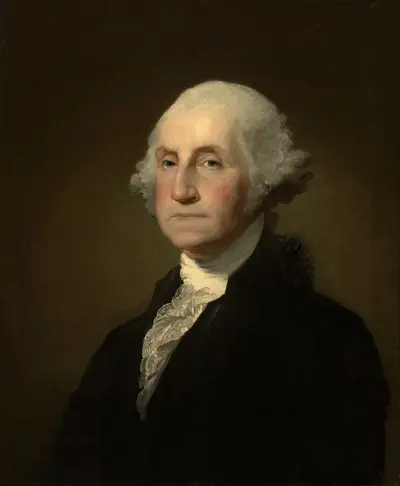
George Washington was the first President of the United States (1789-97), the Commander-in-Chief of the Continental Army during the American Revolutionary War, and one of the Founding Fathers of the United States. He presided over the convention that drafted the current United States Constitution and during his lifetime was called the "father of his country".
