Paul Samuelson Quotes
To a person of analytical ability, perceptive enough to realise that mathematical equipment was a powerful sword in economics, the world of economics was his or her oyster in 1935. The terrain was strewn with beautiful theorems begging to be picked up and arranged in unified order.
Samuelson, Paul A. "Economics in a Golden Age: A Personal Memoir." The Twentieth-Century Sciences: Studies in the Biography of Ideas, edited by Gerald Holton, W. W. Norton & Company, 1972, p. 156.


This quotation illustrates why so many consider Mises a political philosopher rather than an economist. In the latter part of Mises life and career, advances in mathematics and its application to economics revolutionized the field of economics and left Mises behind. Nonetheless Mises’ contribution to the non-quantitative area of economics was substantial, and his influence on others was even greater.


Historically, in the first half of the 20th century, nuclear scientists discovered that probability governed and was necessary for understanding quantum mechanics—the laws of physics governing tiny objects like atoms, electrons, protons and even quarks. To many, this seemed a contradiction in that it was hard to conceive particles following laws and yet behaving randomly at the same time. However, it did not take long before all the scientists adjusted their thinking and learned to live and work with that was then a type of contradiction but is no longer thought so as men and women have learned to think in a new way. This quotation illustrates that the greatest scientists in the world, in a very short period of time, had to change their entire mode of thinking. There were no real holdouts or “conservatives” who wanted to maintain the older values. This would never happen in politics, where change is not accepted very quickly.


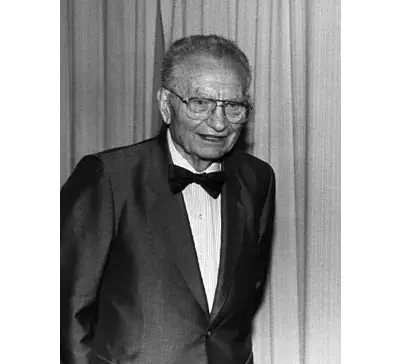
Paul Anthony Samuelson (May 15, 1915 – December 13, 2009) was an American economist who was the first American to win the Nobel Memorial Prize in Economic Sciences. When awarding the prize in 1970, the Swedish Royal Academies stated that he "has done more than any other contemporary economist to raise the level of scientific analysis in economic theory". Economic historian Randall E. Parker has called him the "Father of Modern Economics", and The New York Times considers him to be the "foremost academic economist of the 20th century".
