Calvin Coolidge Quotes
Those who do not want to participate in the spirit of America should not settle in America.
Calvin Coolidge, 1872-1933, 30th President of the United States (Republican, MA), Quoted on PBS, The American President, April 11, 2000
Sourced by: Eigen's Political and Historical Quotations


France had been hit with repeated riots of Muslim and African French citizens and immigrants. Thousands of cars were burned, property damaged and violence of the protesters had injured and killed bystanders. The major complaint was that they were not really accepted as equals in French society. Chirac tried to calm the rioters and prevent a backlash. Although France was a pioneering country in acceptance and tolerance of people of different races and religions, there has always been a strong intolerant segment of French Society that were racist, anti-Semitic and Fascist leaning. Because of the French concept of equality, affirmative action was not legally possible in France so that there was heavy discrimination and even segregation in housing, schools, occupations, and socially. Further, one of the traditional expectations of all immigrants who become French is that they adopt the French language and culture. Like immigrants throughout the world at the end of the 20th century, French immigrants often wanted to maintain their own customs, culture and language—a practice which set them at odds even with otherwise nondiscriminatory Frenchmen and women.


Before the French Revolution, Jews could freely practice their own religion in France but they could not hold citizenship, become professionals, or a host of other privileges of citizenship. Clermont-Tonnerre and other liberals argued that Jews should be given citizenship. The Jacobins--conservative Catholics close to the Papacy--opposed granting citizenship to Jews or Protestants. One argument that the Jacobins gave was that each of these sects would be separate nations within France and not necessarily have French national interest as a priority. Clermont-Tonnerre gave this response which has been the French philosophy about minority citizenship since then. Their thought was that anyone may become a French citizen as an individual but he or she should do so because he/she wants to accept French values and support the French nation. This view worked quite will over the years until the large immigration of Muslims starting in the 1960s where many new immigrants just wanted to live in France and earn a living there, but did not want to identify with French national aspirations or adopt French culture or values. America, had no such demands and those immigrants who tended to identify primarily with their country or culture of origin and not assimilate were allowed to do so, but the American way of life was so attractive that many immigrants did adopt it and even if they did not, their children almost inevitably did. That has not happened in France.
Chautauqua, New York, was a small town in upstate New York that during the summer attracted thousands of people from all parts of the country who were interested in politics and the general condition of society. Major speakers would alternate with discussion groups and debates. It was much like the Aspen Institute except that the costs were very low and many people could afford it.


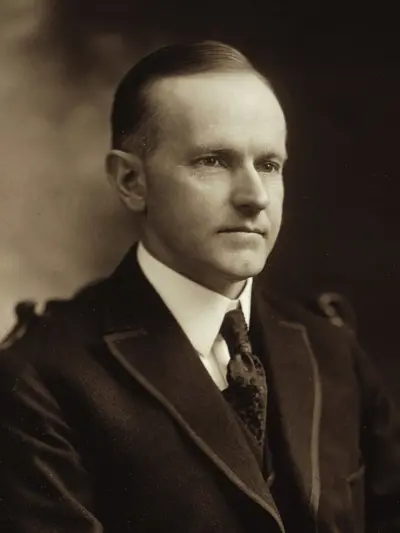
Calvin Coolidge was an American lawyer and politician who served as the 30th president of the United States from 1923 to 1929. A Republican lawyer from New England, born in Vermont, Coolidge worked his way up the ladder of Massachusetts state politics, eventually becoming governor of Massachusetts. His response to the Boston Police Strike of 1919 thrust him into the national spotlight and gave him a reputation as a man of decisive action. The next year, he was elected the 29th vice president of the United States, and he succeeded to the presidency upon the sudden death of Warren G. Harding in 1923. Elected in his own right in 1924, he gained a reputation as a small-government conservative and also as a man who said very little and had a rather dry sense of humor.
