Gottfried Wilhelm Leibniz Quotes
This is why the ultimate reason of things must lie in a necessary substance, in which the differentiation of the changes only exists eminently as in their source; and this is what we call God.
Leibniz, Gottfried Wilhelm. The Monadology and Other Philosophical Writings. Translated by Robert Latta, Oxford University Press, 1898, p. 238.


At the time, it was very difficult for people who had been taught all their lives that God was directly responsible for the creation to accept the notion of evolution. At the time, there was not the overwhelming evidence proving Darwin’s theory that we have today. Nor did theologians realize that evolution and Darwinism were not inconsistent with the concept of a creator and supreme being. Nonetheless, there are still those who, like Agassiz, reject evolution and insist that the Biblical version of creation is literally true. See {586990}. Then there are people who have come up with the concept of Intelligent Design which originated with Agassiz though he never called it that. Most religious people today, in contrast, see no conflict in natural selection as described by Darwin and later proven, and the concept of God. They see the Biblical creation as metaphorical and natural selection as the product of an omniscient supreme being.


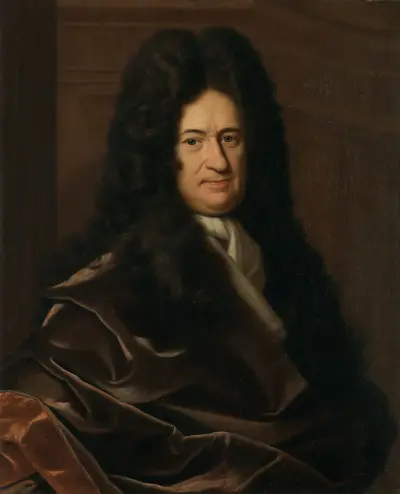
Gottfried Wilhelm (von) Leibniz was a prominent German polymath and one of the most important logicians, mathematicians and natural philosophers of the Enlightenment. As a representative of the seventeenth-century tradition of rationalism, Leibniz developed, as his most prominent accomplishment, the ideas of differential and integral calculus, independently of Isaac Newton's contemporaneous developments. Mathematical works have consistently favored Leibniz's notation as the conventional expression of calculus. It was only in the 20th century that Leibniz's law of continuity and transcendental law of homogeneity found mathematical implementation (by means of non-standard analysis). He became one of the most prolific inventors in the field of mechanical calculators. While working on adding automatic multiplication and division to Pascal's calculator, he was the first to describe a pinwheel calculator in 1685 and invented the Leibniz wheel, used in the arithmometer, the first mass-produced mechanical calculator. He also refined the binary number system, which is the foundation of nearly all digital (electronic, solid-state, discrete logic) computers, including the Von Neumann machine, which is the standard design paradigm, or "computer architecture", followed from the second half of the 20th century, and into the 21st.
