Lyndon B. Johnson Quotes
This is probably the greatest thing that I have ever accomplished but I fear that we Democrats have lost the South for the rest of my lifetime and probably you lifetime as well.
Prior to Johnson’s civil rights efforts, the South virtually always voted for Democrats in all elections. The only political competition was for the Democratic Party Primaries. The term “Solid South” meant that it was solid for the Democratic Party. But after the Civil Rights Act was passed in 1964, the racist whites who used to be Democrats switched and joined the genuine traditional conservative and created a Republican Southern majority that was as solid for the GOP as the Democrats had ever enjoyed.
Lyndon Baines Johnson, 1908-1973, 36th President of the United States (Democrat, TX), Statement to his assistant Bill Moyers after his signing of the famous Civil Rights Act, 1964
Sourced by: Eigen's Political and Historical Quotations

The press secretary found the President very morose the day after his great triumph of passing the Civil Rights Bill of 1964. Moyers asked why he looked so sad.


He was right. Even the vaunted Southern Filibuster was broken by the strategy and tactics Johnson and Senator Humbert Humphry, the Floor Leader for the 1964 Civil Rights Bill.

This was art of the Nixon "Southern Strategy" to alienate the white supremacists and racists from the Democratic Party with Civil Rights legislation and rhetoric, and get most of them to become Republicans. But as Phillips observed, when Negroes began voting in significant numbers in the South the party switching really accelerated.


On why he joined the Republican party:


The Nixon "Southern Strategy" was that if the Republican Party made extensive efforts to appeal to minorities, given the previous decades of support of white supremacy, they would only be successful with a few, whereas if the Party went in the other direction and supported the Whites fighting against the Democratic initiated, racist hated, Civil Rights Act, they would get almost all the racist Southern Democrats, which were most white males and many white females. This racist policy enabled the Republicans to gain control of the Federal Government more often than not whereas before, it was very unusual.


The statement was made even more dramatic as the outgoing Governor, Lester Mattox, standing behind Carter at the ceremony, was an arch segregationist.

It was used as a whipping boy and led to a re-alignment of Southern politicians to the Republican party.

Some had organized and led lynchings; others participated, and others stood by without speaking out.

At the time, there was not only racial discrimination, especially in the South, but lynching—the relatively public and open killing of Blacks and other forms of racial violence were commonplace in Southern America. Truman, himself a Southerner, was considered a traitor by many Southerners because he tried to deal with the Civil Rights problem more vigorously than any previous president. The Democratic Party had “the solid South”—political control of the Southern States and there was an unwritten rule that the Party positions and leaders would not push Civil Rights and would support States rights in law enforcement. The Republicans, in the Lincoln tradition, fought hard for Civil Rights enforcement but were the minority. Truman integrated the armed forces and did what he could do via Executive Orders but could not get any laws through the Congress. When LBJ pushed the Civil Rights Bill through Congress, Southerners became Republicans and the South was solidly in the Republican camp.
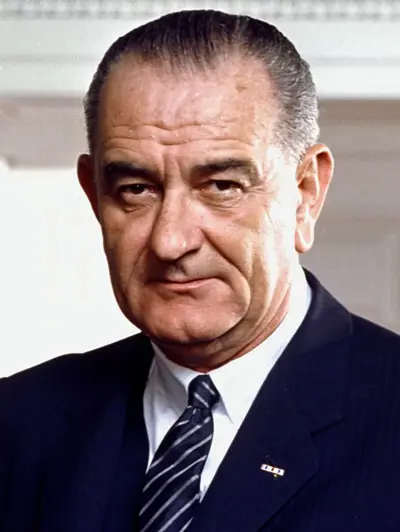
Lyndon Baines Johnson, often referred to by his initials LBJ, was the 36th president of the United States, in office from 1963 to 1969. He served as the 37th vice president from 1961 to 1963 and assumed the presidency following the assassination of President John F. Kennedy. A Democrat from Texas, Johnson was also a United States representative and later majority leader in the United States Senate. Johnson is one of only four people to have served, at various times, in all four federal elected positions.
