Francesco Crispi Quotes
This is a military phthisis not a war … small skirmishes in which we are always facing the enemy with inferior numbers … There is no fundamental plan in this campaign … We are ready for any sacrifice in order to save the honor of the army and the prestige of the monarchy.
Four days later following the urging of their government, the Italians attacked at Adowa and were badly beaten. Baratieri was sacked and court-marshaled but was acquitted. The telegram became historically famous for the political interference problems in military tactics and strategy. Most military observers believe that Baratieri was fighting a winning campaign as the Ethiopians had completely overextended their supply lines and had to forage off the land which was becoming bare. In a few days the Ethiopian army would have started drifting away. But the politicians in Italy wanted honor and a symbolic resounding defeat of the Ethiopians on the battlefield.
Francesco Crispi, 1819-1901, Italian Prime Minister, Telegram to General Oreste Baratieri, the military commander of Italian forces in Africa, February 25, 1896
Sourced by: Eigen's Political and Historical Quotations

Nonetheless and even though he was outnumbered, he was goaded into an attack by Prime Minister Crispi. The Italians lost decisively ending their African colonial plans.

If a military loses a war, it has shown to be insufficient quality; if it wins, the evaluation is good. With all the talk about what makes for an effective and quality military, as the General states, it is war that is the final arbitrator. So ideally we never want to really know how good our military is.


Of the 10, 596 Italian troops, 4,133 were killed or missing and 2,000 were captured. Baratieri was court-marshaled but acquitted. Italy’s imperial African plans were dashed. This defeat did much to create and sustain the poor world military reputation of the Italians extending to this day.

Baratier wanted to defend Fashoda at all costs as a matter of French honor. The Minister was trying to broaden his understanding of French honor and avoid a military defeat. A diplomatic solution was found that preserved everyone’s honor.

The Gladstone government delayes and the force did not arrive on time. The town fell to the Madhi’s forces. Gordon was killed.
In one of the classic disputes between the military and civilian authorities, the government did not want to spend the money or risk the troops to expand French positions. The military officers however had a different view. Humbert suffered a military setback in the field and felt that he was caught in between the higher military and civilian authorities.

There is a striking similarity of speech between Menelik and the monarchs of Europe with respect to his Divine right of rule and dependence on God. Ethiopia, in contrast to the rest of Africa, was a Christian kingdom and had been so for centuries. Menelik mobilized his people and produced a humiliating defeat for the Italians at Adowa in 1896 who never forgot and returned to conquer Ethiopia in the early part of World War II.
Ethiopia, then the only Christian country in Africa, was imperialistic and interested in private military adventurers to expand their empire just as the English, French, Belgians and Germans were. See Menelik’s statement on imperialism {607290}.
The basic treaty sold some of Ethiopia’s colonial territory (Eritrea and Tigray) to Italy in exchange for arms. Italy had tried to conquer the area but lost 500 men in the Battle of Dogali. However, after this peace treaty, Italy maintained that Article 17 of the treaty gave them the right to declare Ethiopia an Italian Protectorate which they did. However, there were two different versions of the treaty that the Italians had drawn up—one in Italian, the other in Aramaic. Britain, Belgium and Germany supported Italy; France, Turkey and Russia supported Ethiopia. Menelik then, to make matters clear, repudiated the treaty in 1893. Italy send an invasion force that was soundly thrashed by the Ethiopians setting the stage for the Italian attack on Ethiopia in World War II years later. Parties to International treaties thereafter have paid close attention to the different language versions.

This line was used in the WPA Federal Theater Project. The play was closed down, because the State Department was distressed that the Federal Theater quoting heads of State might be insulting to the world leaders. Mussolini was another character in the play and he was depicted as the boorish thug that he turned out to be. It was that which offended the government officials who closed the show before it could open. FDR used a similar line 6 years later. See {32529} . Dolores Ibarruri in the Spanish Civil War is quoted with a similar phrase at about the same time. See {604321}

Clark had commanded the American and NATO forces in the Serbian War where all the military and political objectives were accomplished with heavy losses to the Serbian’s and none to the allied side—what many think was the most successful war in American History. Like Eisenhower in WWII one great challenge was the political and strategic one of keeping the coalition of all the allied governments working together. His perspective had been like Eisenhower and other officers in history was much wider and geopolitical than most military officers.

This statement is perhaps the greatest and most eloquent description of the United States exceptionalism and its behavior in WWII. Such a statement could only come from a non-American.

Most of the experienced Southern Military officers were graduates of West Point and elementary and secondary Northern Military Schools, and the South if it were to be independent, would have to have a parallel structure.


Shortly thereafter, Ma Hongkui, and his soldiers ran for their lives and barely escaped to Taiwan as the Communists took over all of the Chinese mainland.

Mengustu seized power in a coup. However his Marxist Dictatorship was very unpopular and a civil war soon started. The poorly armed opposition used guerrilla warfare insurgency techniques. Since the government was hated by most people there was much support for the guerrilla in the villages and countryside. Mengustu adopted a policy of genocide. The areas of the country which were sympathetic to the revolutionaries were then systematically starved by the government withholding food. There was a bad agricultural crop but international donors including the United States provided much food aid. However this was withheld by the government from the areas where there was any support for the freedom fighters. Over 1 million Ethiopian citizens were starved to death. This quotation was one of the important documents that proved that there was a systematic government policy to commit genocide—in this case to “drain the sea”. After the revolution was successful, Mengustu was convicted of Crimes Against Humanity but escaped to Zimbabwe where he was given sanctuary by his fellow dictator, Robert Mugabe. There is a technical issue of whether or not this was genocide in that the exterminated people were not of one race, religion or ethnic group, but the people who were residents of the areas which were giving “aid and comfort” to the freedom fighters.
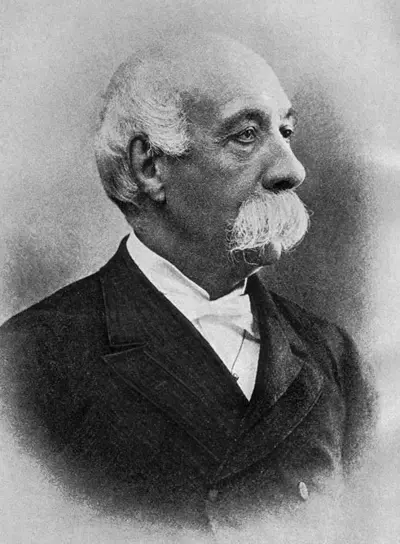
Francesco Crispi was an Italian patriot and statesman. He was among the main protagonists of the Italian Risorgimento and a close friend and supporter of Giuseppe Mazzini and Giuseppe Garibaldi, and one of the architects of the unification of Italy in 1860.
