Woodrow Wilson Quotes
They [the Republican controlled Senate] have shamed us in the eyes of the world.
The President had negotiated the League of Nations as a part of the treaty negotiations ending World War I. However, he could not sell the idea to the Republican controlled Senate and the treaty was never ratified. This was the death of the League of Nations, a predecessor organization to the United Nations. America had gone into a period of extreme isolationism which in many way enabled WWII to get started. After WWII, the nation did not make the same mistake and the establishment of the United Nations was ratified handily. President Truman, however, was a much better salesman than President Wilson had been, and perhaps more important, the Republicans and Congress had never been involved in the League of Nations negotiations, whereas Truman had involved them heavily in a bipartisan effort.
Woodrow Wilson, 1856-1924, 28th President of the United States (Democrat, NJ), Statement when the Senate refused to ratify the League of Nations Treaty, Quoted on The History Channel, The Presidents, November 24, 2005
Sourced by: Eigen's Political and Historical Quotations

Most of the Republicans in the Senate, using the filibuster, blocked legislation making schools and streets safer by expanding the requirement for gun checking to keep mentally ill people and violent criminals from purchasing a gun. The legislation had been crafted by Republican and Democratic Senators and was supported by 90 percent of Americans including 80 percent of Republicans and the majority of hunters and gun owners. This was one of the rare instances where public opinion did not matter at all to the Congress, and while a majority of the Senators supported the legislation a significant minority was more in fear of the NRA and the Gun lobby than they were of the voters. To the Republican minority, the possibility of a mentally deranged, violent, convicted felon, should be allowed to buy a military style assault rifle or any other weapon at a gun show without anyone bothering to check his background was less desirable than requiring gun sellers to spend 3-5 minutes to check out the potential buyer.


While Bannon was more critical of anyone who disagreed wiuth him than most, it was unusual for a conservative to use such harsh tems about a conservative presidential administration.


The majority of the country strongly favored American participation in the League of Nation provided there were some reservations that made it explicitly clear, the American troops could not be committed without the approval of Congress and that nothing would impinge on U. S. domestic sovereignty. Wilson wanted no exceptions or reservations to the treaty he had negotiated and would not compromise in any way. The issues were soon forgotten in what had become a test of will and power between the Senate and the President. The treaty was never ratified and without the United States, the League of Nations collapsed.

Kerry had just finished a formal presentation, and thought that the microphones he was wearing had all been removed. Some opponents accuse him of knowing that he was overheard by live mikes.

This quotation illustrates the unpopularity of President George W. Bush. Not only was he unpopular in America, but this quote shows the same unpopularity with one of our major Western Allies. The critic chides an author—Valerie Morse—for even stating the obvious. The dislike of Bush was so pervasive that even more characterization of his shortcomings was seen as a type of “piling on” and really not even necessary.


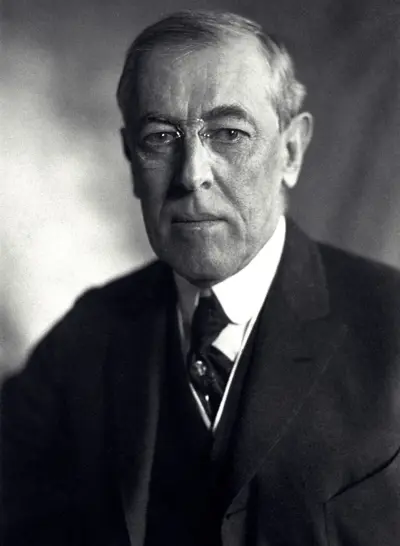
Thomas Woodrow Wilson was an American politician and academic who served as the 28th president of the United States from 1913 to 1921. A member of the Democratic Party, Wilson served as the president of Princeton University and as the 34th governor of New Jersey before winning the 1912 presidential election. As President, Wilson led the United States into World War I in 1917. He was the leading architect of the League of Nations, and his progressive stance on foreign policy came to be known as Wilsonianism. Scholars have generally ranked Wilson in the upper tier of U.S presidents, although he has been criticized for supporting racial segregation and white supremacy.
